Pages

Showing posts with label Iberia. Show all posts

Tuesday, 29 January 2013

Iberia, Vueling and IAG (continued...)

By the way, to clarify, my previous article was motivated by this piece on the FT that points towards IAG using Vueling to cover most of Iberia's short-haul network...

It makes sense on paper, but Iberia's unions have an agreement with the company that prevents Vueling from flying little more than a few routes out of Madrid...this adds to an already very tense labour situation at the Spanish flag carrier.

Monday, 28 January 2013

Vueling taking over Iberia's network?...not so easy...


  Too close for comfort

The more details that emerge of IAG's plans for Iberia, the closer we get to the scenario anticipated in this blog a few months ago (and see also this other post).

Why create a low cost carrier from scratch when you already have one in-house?

It would make sense for IAG (and British Airways) to roll out the Vueling brand across all of Iberia's short haul network...but it won't be easy: there are labour agreements in place whose purpose is to prevent exactly this from happening...so brace for more industrial turbulence on its way!

(Translation: I would check the industrial action calendar before booking any flight with Iberia in the coming months!)

Sunday, 16 December 2012

Vueling's two frequent flier programmes: which one's best?


I am about to book a flight with Vueling and I got to the point where I need to decide which frequent flier programme do I wish to use: Vueling Punto or Iberia Plus?

It seems that, although, both Iberia Plus and BA's Executive Club use the same "currency", Avios, and they both belong to IAG, their frequent flier programmes, unlike, for example, Air France-KLM's Flying Blue, are still run separately.

I am a Vueling Punto member, although I have seldom used it, but I gave up with Iberia Plus and switched to British Airways' Executive Club instead...so it seems that for me the best option is to stick with Vueling Punto but I have made myself the following question:

Are there any specific advantages of being on Vueling Punto instead of being on Iberia Plus? I mean, if Iberia Plus lets you collect avios both on Vueling AND on other Oneworld airlines whereas the former only lets you collect miles on Vueling. What is the point of holding the Vueling Punto? or maybe the "Exchange rate" between punto and Avios is not that favourable?

Any frequent flier programme experts in the room?

Wednesday, 7 November 2012

IAG to bid for Vueling?

To bid or not to bid?

The news was out this evening that IAG is considering a bid for the share of Vueling it does not yet control (here is the official communication on the website of the Spanish stock-market regulator).

We will have to wait until Friday to know the details, but it makes sense...IAG is heading to an attrition war with Iberia's unions over the creation of its new low cost subsidiary, Iberia Express (and after this week's court ruling, there is no solution in sight anytime soon). The "new" carrier is IAG's attempt to stem losses at Iberia, particularly in the short and medium haul network.

And while Iberia is in turmoil, and as I already noted here a few days ago, Vueling (that is 40% owned by Iberia) appears to be in good shape. Such an irony, because Vueling is already exploiting successfully the sort of hybrid model that Iberia Express was trying to bring to Iberia's short and medium haul network!

What next then? 

As I said, it's early to say, the offer has not even been formalized, but things are getting interesting...

Could Vueling take progressively take over the Iberia Express project while Iberia focuses on the long-haul routes? After all, Iberia already had a "sister" company until the 90s, Aviaco, that was doing most of the domestic flights in Spain.

This option might not be good news for Barcelona airport, since there might be a risk, if Vueling "becomes Iberia" that the carrier will shift its focus away from its current base, where a major expansion is currently under way (or alternatively that it will split its fleet and network between Barcelona and Madrid).

Could the goal be merely financial, to consolidated the profitable Vueling operation in the not-so-good Iberia's accounts?

Is IAG planning to keep it as it is now, a stand-alone operation, while trying to extract more synergies and know-how from Vueling's experience in running a successful low-cost (or we should better say "hybrid") operation?

Let's wait until Friday to see whether anything new comes out of Iberia's results presentation!

Sunday, 21 October 2012

Iberia and Vueling on diverging flight paths

I just read an article on a Spanish news portal (in Spanish, "Iberia tenemos un problema"-"Iberia, we've got a problem") that warns about the difficult situation Spanish carrier Iberia is currently in.

Nothing that I had not brought up on this blog before: see my article of just a few days ago ("IAG's Spanish problem, Iberia Express and Vueling").

There are not many successful cases of network carriers creating spinning-off profitable low cost airlines, as noted recently by industry blogger Cranky Flier, not to mention the adverse effect it could have on your brand.

In Iberia's case, the problems are compounded by ongoing labour litigation that could take away all the labour cost reductions achieved with the creation of Iberia Express, its new low cost subsidiary...

Going through turbulence...

The ironical thing here is that, while this happens, Vueling, an airline that is 40% owned by Iberia, seems to be going from strength to strength, and it is actually "upgrading" its brand and services and recently announcing a major fleet and network expansion at its Barcelona base (although some Vueling frequent fliers tell me that the carrier has still some way to go in terms of reliability and customer service in order to shake off the "low cost" label completely).

An interesting case of business-fiction prospective would be the situation where Vueling ends up taking over Iberia's short and medium haul operations...seems quite far fetched at present, but about a decade ago we saw former regional operator Crossair taking over its bankrupt parent, the once mighty Swissair and more recently Austrian Airlines corporate structure being gradually folded under Tyrolean Airways (although keeping its brand).

Sunday, 30 September 2012

The weekly airline business recap

While many in the airline industry will be enjoying the warm weather at Abu Dhabi for #Routes, I thought about putting together some of the airline stories that caught my attention this week...

Starting with Thai Airways. getting its first Airbus A380 (the first of 6 ordered by thailand's flag carrier). I had the chance to attend the delivery ceremony in Toulouse and will certainly be publishing a longer blog post about this event shortly, but in the meantime you can check out what Flightglobal wrote about it.

By the way, Thai's A380 fleet will be growing soon, aircraft number 2 and 3 are already in Hamburg to  get all the necessary fittings, while number 4 is already out of the assembly line, you can see it here, next to two Malaysian A380s (there was also a China Southern A380 next to them).

More A380s ready to head East, where growth is

And the "low-costization" of European short haul continues with Lufthansa's announcement that it is going to launch a low cost airline of its own, integrating Germanwings operation along the way. While the new brand will be, for a start, restricted to Germany's non-hub airports, will see if it ends up like Iberia Express, taking also a sizeable share of the flag carrier's mainline operations.

By the way, Airbus marketing VP Bob Lange reaffirmed to a group of journalists attending Thai Airways' A380 delivery ceremony that the European consortium is sticking to its sales goals for the year, that is, of selling 30 more A380s. This was hours before Emirates Tim Clark expressed interest in acquiring another 30 to 40 A380s in the near future...coincidence?

In any case, with more A380s or not, the story of growth in the United Arab Emirates airline industry is simply amazing, as this report confirms, from 18 million in 2001 to over 70 million in 2011 and I guess it would look even more spectacular if we went 20 years back in time.

Oh! and I almost forgot...I got to fly BA's "Dove"!

Monday, 10 September 2012

IAG's Spanish problem, Iberia Express and Vueling


The future does not look bright for Iberia. IAG latest financial results showed that the Spanish flag carrier has become a drag on the the group's financial performance. IAG's CEO, Willie Walsh has already warned that tough measures must be taken...

And what now seems inevitable is that Iberia's short and medium haul network will be progressively taken over by Iberia Express, the vehicle that IAG has chosen to get rid of the existing labour relations framework at Iberia. For Iberia's customers the change to Iberia Express should not be a big change...for now...because, Iberia Express might have been helpful in taming some structural cost issues within the company (Iberia Express is already profitable), however, it can do little against the huge exogenous pressures currently affecting the Spanish air travel market, like the deep economic crisis and the strong competition from other low cost carriers (among the major European markets, is possibly the one where LCCs enjoy a larger marjet share).

So it is not unlikely that, while keeping some network carrier features, most important of all, feeding Iberia's long-haul network, or what's left of it, Iberia Express, and the rest of the airline, might have to undergo a process of "low-costization".

Curiosly enough Iberia is the major shareholder of another Spanish low cost, and one that is profitable: Vueling. The Barcelona-based carrier is actually on an opposite path: whereas Iberia might end up trading-down, Vueling is trading-up and offering more and more extras to its passengers, in a drive to attract business customers.

Will Vueling and Iberia (Express) end up occupying the same market space?

If this happens, will the two brands be kept? In theory, there is no need to, despite its shareholding Vueling is an independent company and it has its hub at Barcelona, whereas Iberia Express is based at Madrid. However, it is not unthinkable that Vueling becomes more operationally entangled with Oneworld's operations in Spain as it starts to codeshare more and more, take on feeding operations, etc. Will there be a temptation to consolidate Vueling and what's left of Iberia in a big low cost operation? Who would then have the strongest brand? and right structure and "mind-set" to operate as a low cost?  an strengthened Vueling or a "downgraded" Iberia?

Of course, the most likely outcome is that nothing of this might actually end up happening, but "what if" scenarios are always entertaining...

Tuesday, 8 May 2012

British Airways to be soon owned by...the Spanish state?


One of the side-effects of the economic and financial turmoil in Spain might be none other than British Airways falling back into government hands...but in the hands of the Spanish state this time!

How's that?

The main shareholder of British Airways' parent company, International Airlines Group (IAG) is non other than Bankia, formerly Cajamadrid (Madrid's savings bank before the latest reform of the Spanish financial system), with over 12% of IAG's capital (a vestige of the times when Cajamadrid was one of Iberia's main shareholders). The fact is that Bankia is in deep financial trouble, so deep that all points towards a bail out and nationalization by the Spanish government, who would then, through the back door, control 12% of IAG...

But before you start fretting about a new Spanish Armada taking over the British flag carrier, have a look at IAG's consolidated accounts and you will see that British Airways is bringing in all of IAG's profit  (is losing less money than Iberia)...so, whatever happens, I would expect Willie Walsh to remain firmly in command!

Thursday, 15 March 2012

Iberia Express update

Just a quick update on my previous post about Iberia Express where I posted a link to what looked like the new airline's livery. Today Will Horton has tweeted the following picture that confirms the simple mainly white livery of the "new" airline.

With this livery Iberia is possibly wishing to highlight the fact Iberia Express is a "lite" version of itself. I must say I am unimpressed by this design, however this approach might make sense if what you are willing to sell is an unexpensive, basic product stripped out of all unnnecessary extras. Finnair recently moved also to a mainly white livery, although for a different set of reasons.

Tuesday, 13 March 2012

What's really new with the new Iberia Express?

Time to maneuver for Iberia
The answer is: very little!

For those readers that might not be familiar with the whole story, Spain's flag carrier Iberia, now part of the IAG Group, is starting a new low cost airline that is to take over most short -haul routes from its parent company, so that what's left of Iberia can concentrate on the long-haul, primarily its most important market: the links between Spain and South America.

This move is due to the need to lower costs, forced by the strong competition Iberia is facing at its own hub by low cost carriers (Ryanair is already number one airline in Spain!).

A new airline in Spain then? hardly...well at least from the point of view of passengers (if you are an Iberia pilot, this is another matter). From the informations that are being made public, Iberia Express product is not going to be significantly different from that Iberia currently offers on short-haul routes:

Same aircraft, as Iberia Express is going to use Iberia's current A320-family fleet

Same route network as Iberia Express will be progressively taking over some of Iberia's domestic and, at a later stage, European routes (while possibly Iberia proper might keep some key European routes with heavy business traffic such as those from Madrid to London Heathrow and Barcelona).

Same level of service: while it is still not sure whether Iberia Express will offer single-class service or provide some sort of premium service, for those flying economy there are possibly going to be any noticeable differences, since Iberia has long been a no-frills carrier when it comes to economy class on short-haul routes.

I also assume the new airline will use the same commercial channels than Iberia and that you will also be able to buy connection flights and multi-leg flight itineraries, after all one of its major roles would be to feed Iberia's long-haul, and Iberia's American network would not be viable without its large proportion of connecting passengers.

Why go all the way and create a new airline then?

It's primarily a legal and labour relations matter...as IAG chariman Fernando Vazquez explained at a recent conference at the London School iof Economics, Spanish labour laws made almost impossible to change the labour relations framework within the company, so it was easier to start an entirely new entity and transfer its assets to it. Of course this has not gone down well with Iberia's unions that have resorted to a protracted industrial action campaign.

IAG's CEO, Willie Walsh, seems unimpressed, as he is well aware that Iberia is IAG's underperforming leg (while BA made €592M in 2011, Iberia lost €61M.) and can ill afford to keep its high-cost structure if it wants to survive and be around in the long-term.

Iberia is not alone in this move, Air France is also trying to cut costs the same way, although its efforts have focused on French provincial cities that had limited Air France service, rather than in its own hub.

It is not the first time Iberia enters the low cost market, it already did it with Clickair, a low cost it started to compete with then-startup Vueling in Barcelona (with whom it later merged) and in the last few years through its shareholding in vueling, but these were projects with a life of their own...we'll see how it works when applied to its own brand...

By the way, for those of you that are into planespotting, here is a picture of what looks like Iberia Express' first aircraft, there is no consensus as to whether this is the final livery or not, though!

Saturday, 14 January 2012

The Spanish airline industry, in a state of flux


A constant flow of news is coming out of the Spanish airline industry, making it one of the hotspots of the industry in Europe, so I thought about writing this post to summarize what is going on...

One of the most amazing things is that the deep economic crisis that Spain is currently going  thorugh is not enough to deter Spanish airline entrepreneurs...one of the most exciting developments we have seen in last few months is the set-up of "stealthy" Barcelona-based airline startup, Volotea. Little is known about this project so far, except the identity of the founders, the fact that it is going to operate in the short-haul market and that its fleet is going to be composed of Boeing 717s. All these details, that were already advanced in the post I wrote a few weeks ago, have now been confirmed. Some reports in the press pointed also to the fact that it might not restrict its operations to the Spanish market only.

This is certainly an interesting timing to get into Spain's regional market, as the main incumbent in this segment, Air Nostrum is grounding up to 15 aircraft, reducing the number of staff and considering to move its headquarters from crisis-hit Valencia, on the Mediterranean coast, to the Basque city of Bilbao.

Air Nostrum operates many regional routes within Spain on behalf of Iberia

At the same time Vueling has announced an investment of €325 million and a major expansion at its Barcelona base, with 5 new Airbus A320 based there and the launch of 23 new routes. This will bring Vueling's total number of cities served from Barcelona to 70, which makes it one of the largest short-haul networks in Europe.

Vueling's recent network expansion strategy is also worth of note, not only from a quantitative but also from a qualitative point of view...I wrote not long ago about how Barcelona could fulfill its hub ambitions by having an airline develop a network linking it to second and third-tier cities around the Western Mediterranean. The aim would be to become the reference hub for this region, in a way similar to what KLM does with its links between Amsterdam and British and Scandinavian regional airports. When I wrote this what I had in mind was more of a regional type of operation (as KLM does) and I still have serious doubts about whether the Airbus A320 is the right aircraft for this type of operation based on thin routes, but Vueling's route map, particularly in France, with additions such as Bordeaux, Lourdes, Marseille, Nantes and Brest, and Italy, with Genoa, Pisa, Verona,...plus its new "connection flight" service seem to fit well with this strategy. Whether this will ultimately lead to the materialization of the much-awaited long-haul hub at Barcelona remains to be seen...

It is also noteworthy that Vueling is finally launching its first UK routes out of Barcelona (it flies already between the UK and several Spanish regional airports), a territory that, until now seemed reserved to the likes of Easyjet and Ryanair (by the way, the Irish airline has finally closed a deal with the Catalan government that will provide for 19 routes being launched or reinstated at Girona airport (GRO), just one hour drive North of Barcelona, BCN).

In the meantime, Barcelona's other carrier, Spanair, is languishing while awaiting its possible acquisition by Qatar Airways. Senior officials from the Catalan government and Barcelona City Council flew to Doha a few days ago to discuss the sale of Spanair to the Gulf carrier. As pointed out in this post, it will be interesting to see how petro-dollars affect the competitive landscape in the European airline industry. These negotiations, however, have not been obstacle for Qatar Airways to cooperate closely with Spanair's rival Iberia, to the point that it will be the only non-Oneworld airline to use Madrid's gigantic T4 terminal. Qatar Airways' passengers will also be able to use Iberia's domestic network for onward flight connections.

And I finish this post, precisely, with Iberia, as it is preparing the launch of its new low-cost airline Iberia Express. In reality, I think this move will be hardly noticeable to the average passenger: Iberia Express will be using the same aircraft and fly the same routes that Iberia already does, plus it will also offer business class. Iberia's on-board service on short-haul economy is already barely different to that of low cost airlines so not much of a change here either. So Iberia Express is more of a way to end a bitter labour dispute and lower operating costs in its short haul operations, a necessity for Iberia considering how entrenched Ryanair and Easyjet have become in the Spanish market, rather than the launch of a truly "new" airline.

Wednesday, 16 November 2011

Iberia wants you to Fly Around the World with its new Facebook game


Gamification is the word of the moment in social media and airlines are starting to experiment with it. Spanish flag-carrier Iberia, now part of the IAG Group, is the latest airline to experiment with this channel in order to generate buzz and follower engagement.

Iberia has just launched "Flying Around the World", a Facebook game here users can accumulate "hours of flight" by answering questions related to the airline and its products and services, the goal is to accumulate these hours of flight, you start as a co-pilot on short haul flights and become "Long-haul Pilot" (Comandante de largo radio), you can answer up to five questions per day and each correct answer gives you "flying hours".

Each question is labeled as a "flight", for example to complete a Madrid-Milan flight I had to answer how Iberia's last minute discounted online booking service is called (answer "Los que Corren, Vuelan" ("those that run, get to fly"). Iberia will be progressively adding new flight sectors over time,as the goal is to keep users engaged. As any good social media "trap", you get extra points for liking Iberia's Facebook page and leaving them your email (not that they hadn't it already!).

The more "zones (Europe, Latin America, etc.) you complete, the more chances you have to win in the draw that takes place at the end of the contest (15th December). Iberia will throw in "special" sectors to cover from time to time, as a chance to accumulate more "flight hours".

The prize? You guessed it!
4 free flights for the select few to any of the 24 long-haul destinations on Iberia's network (or "Avios" Iberia's, and IAG's, frequent flier "currency")

I was playing around with it a little bit, an, although the mechanics of the game are not particularly revolutionary, it is a nicely executed project that makes for some good light entertainment while you recall the extent of Iberia's network...I'll let you know in case I win!

Sunday, 30 October 2011

Qatar Airways about to invest in Spanair and why this is good news for Barcelona airport (I)


I just learned that Qatar Airways might be about to acquire a 49% stake in Barcelona-based troubled airline Spanair. While I do not know the details of the deal, I can think of a few reasons why this could be a good move for all parties involved, as well as for Barcelona's airport.

First of all, is a matter of financial necessity and of urgency. Spanair is in a critical financial situation and, despite strong backing from the Catalan government, is quickly running out of cash. Since I wrote this note a few months back it seems Spanair's cash-flow position has only got worse.

An investor with deep pockets is needed in order to keep the airline flying and allow the Catalan government to save face and disentagle itself from an operation that is difficult to justify at a time of tough budget cuts, while claiming a partial success at keeping Barcelona's long-haul hub aspirations alive.

And this takes us to the next factor that I think it makes a tie-up with Qatar Airways a potentially interesting proposition and this is none other than opening a window to the East and to the globe's currently most dynamic economies. On June 2010 I commented on this blog how commercial aviation's center of gravity is moving East and any carrier and airport with aspirations should try to ride this trend. A link with Qatar would certainly help Spanair and Barcelona airport gain this intercontinental dimension they have been so much longing for.

A side effect of a re-capitalized Spanair is that it will put pressure on Vueling, Barcelona's other airline, that is already being squeezed by Ryanair's increasing presence at BCN. Having to face renewed competition from a stronger Spanair will certainly not help recover its margins. It will also prevent Vueling from becoming the only carrier able to build some sort of air hub at Barcelona. Although Vueling has been developing some flight connectivity at BCN there are serious doubts about Vueling's capacity to build a fully fledged hub at the shadow of Iberia, that remains its main shareholder, since any such move would risk cannibalizing Iberia's operations in its main Madrid hub.

In my next post I am going to present some interesting strategic questions that arise from the possible imminent completion of this deal...


Friday, 15 April 2011

Vueling and Spanair: two different strategies to develop Barcelona into an airline hub

A few weeks ago I presented my vision of Barcelona airport as at potential Mediterranean hub. But are there any airlines able to turn this idea into a reality?

Actually, the chances of this happening, although small, have never been better, as there are currently two airlines aiming to develop a hub-style operation at BCN: Vueling and Spanair, however each of them has its particularities.


Spanair MD-83 EC-GVO with the city of Barcelona in the background

On one hand, Vueling started as a pure low cost play, although its model has been going through an hybridisation process that has seen it progressively adding more of the features of a network airline. On the other hand, Spanair's troubled existence as a conventional full-service airline, took a radical turn when a group of investors supported by the Catalan government purchased it with the mandate to develop an international hub out of Barcelona.

Spanair is actively marketing itself as "Barcelona's carrier", the only one able to take Barcelona to the first division of European airports. Spanair's latest marketing campaign, Jo Crec en Barcelona (which means "I believe in Barcelona" in Catalan language) goes in this direction. But how does this translate in terms of network development?

Until now most of Spanair's growth, which has been constrained by the carrier's delicate financial situation, has been aimed at leveraging its Star Alliance links, new routes and frequencies between Barcelona and Germany and code-sharing with Singapore Airlines, as well as developing some niche markets out of Barcelona with routes to North Africa and the Sahel (Algiers, Nador, Banjul, Bamako and the, now abandoned, Tripoli). This niche market strategy would fit well with the concept of a Star Alliance South-Western European hub, by offering a diversified and unique route network and channeling traffic through Barcelona, however, given Spanair's weak European network outside Germany, it remains unclear to me what traffic is going to feed these specialty routes other than a limited domestic Spanish demand and some spillovers from Star Alliance's main hubs in Central Europe.

In my post about the Mediterranean strategy I pointed at the need to achieve some critical mass by linking those cities that are within easy reach from Barcelona and are somehow underserved buy their own flag carriers. And this is what Vueling seems to be doing. This airline, partly owned by Iberia, is strengthening its network by opening routes from Barcelona to a number of airports in Southern France (Bordeaux, Toulouse) and Italy (Genoa, Pisa) in addition to a very strong Spanish and European network, at the same time it is enabling connections between different flights and feeding Iberia's new transatlantic services at Barcelona (to Miami and Sao Paulo). Does this mean the hub status for Barcelona is getting closer? yes and no, in a way the seeds of a potential Mediterranean hub are being planted, but at the same time, Barcelona is still far from enjoying the sort of coordinated waves of arrivals and departures, network reach and feeder frequencies that even secondary hubs have.


Vueling A320-200, EC-ICS, landing at BCN

Another question is whether is there enough space at BCN for two airlines aiming to make it its hub, particularly when factoring in the increasing competition from Ryanair...maybe developing a hub would require combining Vueling's European reach with Spanair's niche network...but this is another story!

Wednesday, 23 February 2011

Allplane quoted at AirObserver blog: commenting the new scenario at Girona airport after Ryanair's massive route cancellation

In this blog I speak often about the constantly evolving situation at Barcelona and Girona airports. It is a very interesting case of interaction, in one single metropolitan market (Barcelona-Girona-Reus) of pure low cost players (Ryanair), airlines developing an hybrid model (Vueling), an airline trying to develop a hub-and-spoke operation (Spanair), a retreating flag-carrier (Iberia) and all of this while it is becoming an emerging destination for major global carriers (Singapore Airlines, Qatar Airways, Delta Airlines).

This environment has not gone unnoticed to other European bloggers and AirObserver has just written a piece where it quotes me and presents my point of view about an hypothetic post-Ryanair Girona airport. This is a topic on which I am going to write a piece soon...In the meantime, great thanks to AirObserver for presenting my thoughts on the issue to its readers!

Saturday, 5 February 2011

The legendary air shuttle Barcelona-Madrid: the "Puente Aéreo"


Early morning at Madrid airport, a familiar view for many Barcelona-based passengers

If in my previous post I explained how the Spanish airport authority is using replicas of some venerable aircraft to advertise her state-of-the-art facilities and, for this post, we are not leaving Spain yet, because during my recent trip to Madrid I had the chance to experience another of Spanish aviation's legendary institutions: Iberia's "Puente Aéreo" (the Air Shuttle Barcelona-Madrid).

For those who are not aware, Barcelona-Madrid happens to be the air route with most traffic in the Europe, with nearly 3 million passengers per year and around 70 daily frequencies in each direction.

A large share of this traffic went through Iberia's "Puente Aéreo", an air-shuttle that was conceived as a commuter service, where you do not need a previous booking, you just show up at the airport and get on the next available flight. If a plane is full another one departs shortly after, with frequencies at peak hours could rival those of overground public transportation, every 15 minutes or so. The idea is to provide plenty of flexibility and short waiting times at airport.

The "Puente Aéreo" has its own brand identity and fare structure, separate from Iberia's other flights, even when they are doing the same route (around half of Iberia's frequencies on the Barcelona-Madrid route correspond to the "Puente Aéreo" service, with the rest being regular flights that require reservation.

The "Puente Aéreo" has been a sort of second home to generations of businessmen and politicians, ready to pay for all this flexibility and convenience and it is no wonder that, for years, it has been Iberia's most profitable route (in a way, the "Puente Aéreo" is to Iberia what LHR-New York is to British Airways)

However, a number of changes that have affected the competitive environment in which the "Puente Aéreo" was born and developed.

The first one was the liberalization of European skies. As soon as European skies opened up, new entrants Spanair and Air Europa decided to give it a try. The route quickly became a mainstay of Spanair, that now boasts 8 daily frequencies on the route and has branded the service with a similar name, making use of the concept of "air bridge", although for legal reasons it can not call it "Puente Aéreo", so it has "Puente a Barcelona/Pont a Madrid" instead. Next came low cost airlines, with Vueling entering the fray, it has now 11 daily frequencies. Surprisingly Easyjet chose not to compete on the route in spite of having a base in Madrid. Despite all this new competition, Iberia's market share on the Barcelona-Madrid air market remains at around 45%

The completion of the high-speed railway between Barcelona and Madrid has had a stronger effect on the route as it has emerged as a real alternative in terms of frequency and comfort for business travellers, taking half of the market on the Barcelona-Madrid corridor. It has forced Iberia to reduce capacity, maintaining frequencies but deploying smaller aircraft. However, the 600 kilometers between Barcelona and Madrid are really at the edge of what is considered to be a competitive distance range for high-speed railways and the airplane remains competitive, even for origin-destination traffic. Competitive pricing and the high volume of Catalan transit passengers at MAD have helped the airplane hold its ground on this route.

I am wondering what will happen the moment Ryanair starts flying between the two cities, it now has a base in both so it sounds like a logical next step...but I think the other airlines operating the route will feel the pinch, as they rely on a more price-conscious type of travele. My guess is that the "Puente Aereo" itself will be relatively inmune.

Thursday, 13 January 2011

When a direct flight is not really a direct flight?

I was recently at Barcelona airport and something caught my attention: in all airport screens, and also in the airport guide, I could see announced some flights operated by Iberia to destinations in North and South America (New York, Bogota, Mexico...), nothing unusual if I did not know that Iberia does not currently operate long distance flights at Barcelona (it is opening BCN-GRU and BCN-MIA in March). Passengers on these flights need to change planes at Madrid, however, nothing in the flight information suggested that was a non-direct flight.


Can you tell which of these flights are really direct?

Many airlines do code-sharing on certain routes, so you might end up flying with a different company to that you have booked the flight with, but I haven't come across (yet) a case where an airline markets a non-direct route, involving a stopover an a plane change, as a direct flight (if you do, please let me know!).

For example, in this snapshot from Aena's website (Spain's airport operator) you can find a Barcelona-New York (JFK) flight operated by Iberia, however when looking into the details this happens to be a non-direct flight.


Aena's website shows two Iberia flights BCN-JFK, the first one is a code-shared American Airlines direct flight, the second one does not really show a direct flight, but an indirect route to the Big Apple

It turns out that Iberia has been marketing for years something called "Catalunya-America": these are, basically, some flights specially timed to provide connections, via Madrid, to some American destinations. The way these flights are marketed has sometimes led people to believe those were really direct flights and it has been a source of misunderstandings.

From what I have seen so far on this case, I found the information provided by Iberia on these flights to be a bit misleading to the uninformed passenger. Despite the fact that they might be well coordinated to enable connections, these are still non-direct flights and this should be made more clear when marketing them.

What I am wondering is why Iberia can present these non-direct flights with their own codes as proper direct flight. What prevents Lufthansa, for example, from showing a Barcelona-Beijing or Barcelona-Bangkok flight, that would in all cases involve a Frankfurt or Munich stopover, as direct flights?

If someone could clarify these points I would be grateful...

Saturday, 18 December 2010

Food provenance, authenticity and airline marketing: providing an in-flight gastronomical experience


Alaska Airlines Boeing 737 with wild salmon livery
(photo by Frank Kovalchek, via Wikipedia)

A few days ago I came across a couple an interesting article on Airline Trends (a great blog that I recommend to anyone interested in airline marketing, by the way!) that focused on how food can be a great way for airlines to differentiate their offerings and improve the traveler experience.

This is a topic that deeply interests me and I think airline's initiatives in this direction are very consistent with the ongoing trend towards introducing more doses of authenticity in the consumer experience, something you can see for example if visiting any UK supermarket, where products come with more and more provenance references in their packaging...so I thought about a sharing an article that friend site GourmetOrigins.com has just published about authenticity and provenance in in-flight meals.

Food origins up in the air (via GourmetOrigins.com)

I hope you enjoy the post and please do not hesitate to contact me if you know of any more initiatives of airlines using on-board food provenance and authenticity for marketing purposes!

GourmetOrigins.com is a site to discover and explore the origins and stories of the best European foods, find out where they are made, how and by whom!

Sunday, 18 April 2010

Planespotting at Madrid Barajas

While we wait for the volcanic ash to dissipate, here are some pictures that I took on a recent trip to Madrid Barajas (MAD) a very interesting airport for planespotting and one of Europe's main connecting hubs if you are flying towards Latin America. It is certainly the best place in Europe to spot planes from that part of the globe. I hope you enjoy the pictures!


An Easyjet A319, Easyjet has built an active base at MAD in the past few years despite strong competition from Ryanair, Vueling, Iberia, Spanair and Air Europa, all of them with an important presence at Madrid Barajas.


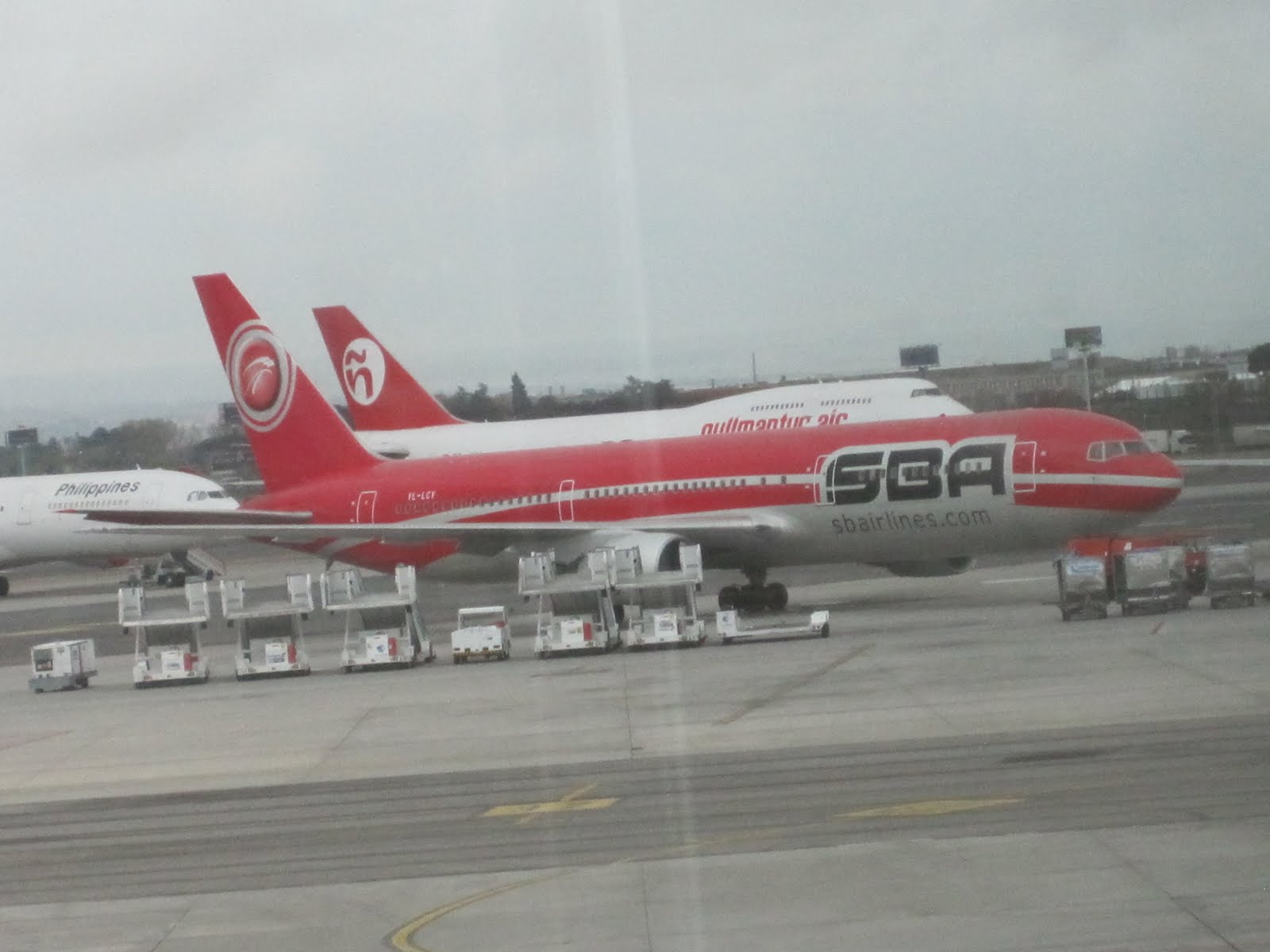
A Boeing 767 of Venezuelan airline SBA (formerly known as Santa Barbara Airlines), that covers the route to Caracas.


One of Air Europa's A330, Air Europa is the Spanish member of Skyteam


A Philippines Airlines A340. Despite being a former Spanish colony, the air links between the Philippines and Spain are very few. This is actually the first time I see a Philippine plane at Madrid Barajas.


If this post is about MAD, Iberia could not be missed. Here a McDonnell Douglas MD-87, one of the few left in the fleet, that is progressively becoming Airbus-only.


A Boeing 757 operated by Spanish carrier Gestair Cargo. The image quality is not very good as I got some light reflected on the terminal's windows...


An Aerolineas Argentinas Boeing 747 getting ready for the daily night flight to Buenos Aires (EZE)


Swiss A320, a regular visitor at MAD.


A colourful livery by Brazilian airline TAM. Already in a World Cup mood!


A pair of Jumbos operated by Spanish charter carrier Air Pullmantur, usually flying Spanish tourists to the Caribbean beaches.

Wednesday, 20 January 2010

What happens when a major airport loses all of its traffic overnight?


Foto by Flickr user Berto Garcia under a Creative Commons Attribution Generic 2.0 License.

Last week I landed at the old terminal (T2) of Barcelona airport for the first time since the new terminal (T1) became operational at the end of last summer. Both terminals are actually part of the same airport (BCN), but they are physically separated, and they actually look like two separate airports, with the new terminal duplicating the capacity of the old one (see this story I wrote a few months ago)...and this is the problem! All three major airline alliances have moved to the new terminal, and the old one, that used to handle over 30 million passengers a year, is now virtually empty...well, not totally, a handful of airlines, with Easyjet and Air Berlin the largest of them, and some charter flights still use it, but the drop has been dramatic (the night that I landed, my Easyjet flight was the only one on sight). This is not totally bad for the passenger, that can enjoy plenty of space and no hassle, but it must have required a strong readjustment to the many shops and businesses that used to operate (or that still are) in the old terminal, and, most important of all, it sets a challenge upon the airport managers to find new traffic to fill the void.

Is Ryanair the solution?


Foto by Flickr user Andy_Mitchell_UK under a Creative Commons Attribution Generic 2.0 License.

The Irish airline has been quick to grab some of the extra available capacity and it has already announced its landing at BCN. Ryanair has already proven it can do well in the Catalan market, that already hosts two of its bases (Girona and Reus), both within one hour drive of Barcelona and I have no doubts that it will also do well in BCN. The airport authorities deny that Ryanair will enjoy any discount on its operating fees (a previous request that the Irish airline seems to have finally dropped), but one of the concerns remain: will Ryanair grab market-share up to the point where BCN becomes, over the long term, a Ryanair-dominated airport? this thought surely worries all those local stakeholders that over recent years have been working to make Barcelona a real contender in the European aviation scene (the lack of intercontinental routes is still BCN's main weakness). A precedent exists and it is positive, Ryanair also moved to take spare capacity after the T-4 terminal at Madrid-Barajas was inaugurated and its presence in that airport has contributed to a more competitive scenario that has benefited travelers. However, it must be said that whereas Madrid could count with the solid presence of Iberia as the dominant carrier, the situation at BCN is a bit more volatile, and the situation of the two main carriers currently operating out of BCN, Spanair in the full-service segment and Vueling as low-cost, looks (at least on paper) a bit more fragile...They have reasons to worry when seeing Ryanair at the gates...