
One of things I am wondering is how Felix Baumgartner managed to land at exactly the right spot from so high up...because landing can really be an art, be it because of adverse weather conditions or because the the airport is in a "challenging" location...and some of the most challenging airports are located in small islands, where it can often be difficult to find enough flat land to be able to build a runway. Have a look at these islands airports to see what I mean...!
Madeira
In this video you will see several aircraft landing in cross-winds at Madeira airport, a landing streep embedded between a steep hill and the sea. I found particularly interesting the landing of Air Berlin aircraft from minute 9 of the video!
Vagar, Faroe Islands
The interesting here is the shape of the runway, that is not exactly flat, but adapts to the curvature of the terrain (this airport, built by the British during WWII is possibly worth a blog post of its own!)
Saba, Netherlands Antilles
If Madeira's airport looks challenging, what to say of Saba's!
Showing posts with label Air Berlin. Show all posts
Showing posts with label Air Berlin. Show all posts
Monday, 15 October 2012

Monday, 8 October 2012
Airline alliances & the Gulf carriers: if you can't beat them, join them!

Making new friends
Today it's been confirmed that Qatar Airways is joining Oneworld, while Etihad has inked a codeshare agreement with Air France-KLM and Air Berlin (that despite being in Oneworld is partly owned by the Abu Dhabi carrier). And all of this with the Emirates-Qantas agreement that, although more limited in geographical scope than the three main alliances, promises to transform the Europe to Australia air travel market.
What next? A growing role for Turkish Airlines within Star Alliance? Emirates joining one of the alliances (they were talking with American Airlines' parent AMR) or creating its own alliance by striking deals similar to the Qantas one with other airlines?
What's clear is that the old saying still holds true: if you can't beat them, join them!
UPDATE: (or in this case it would rather be: "if you can't beat them, try to get them join you!)
UPDATE: (or in this case it would rather be: "if you can't beat them, try to get them join you!)
Friday, 6 January 2012
The long-awaited European long-haul low cost revolution
Are low cost long-haul airlines finally coming to Europe (to stay)?
Well, to be fair, long-haul low cost airlines have operated in Europe before, but for a number of reasons they have never been able to consolidate.
From the early days of pioneering Laker Airways, back in the seventies, to the more recent Oasis Hong Kong (not to be mistaken for Oasis Airlines, a Spanish charter airline that ceased operations in the mid-nineties!), that flew Boeing 747s between London and Hong Kong, and Air Madrid, that collapsed in the run up to a Christmas holiday leaving thousands of passengers stranded, all attempts to establish the low cost long haul model in Europe have been met by failure so far...No wonder that with this track record Ryanair's rumored long haul expansion, expected to start with flights to New York Islip, hasn't materialized yet! And it is not only Europe, we find a similar situation in the US (I do not count transcontinential routes as long-haul).
The economics of long haul low cost aviation are certainly more challenging than those of the short haul variant: aircraft can not do multiple rotations, there are few long haul markets whose traffic is dense enough to support point-to-point operations without the support of a feeder, it is more difficult to take part of the market from alternative modes of transportation such as road or train (basically most of those that can or would fly are already doing so) and also most routes outside Europe are governed by a strict framework of bilateral agreements that provide little flexibility to new entrants.
However, there is a region og the World where long haul low cost carriers are not only well consolidated but also expanding fast. Air Asia X and Jetstar, that from their respective bases in Malaysia and Australia are currently competing to establish subsidiaries across the region. Singapore Airlines is also launching its own low cost airline, Scoot. And Australia's Strategic Airlines has also joined the fray after rebranding itself as Air Australia.
But in such a global industry, it is rare to see a trend confined to a single region and I think we are going to see long haul low cost airlines take hold in Europe really soon, with airlines from the Asia-Pacific region leading the way: Air Asia X is already at London Stansted and some more routes are being planned. Jetstar has also announced plans to enter the European market.

And we are starting to see some movement among European airlines too, with Norwegian leading the way, and XL Airways in France are also pondering whether to make the move (Air Berlin is also offering long haul but I would count them more as a hybrid airline rather than low cost). Delays in the production of the Boeing 787 might be delaying some long haul plans (its, in theory, superior economics might help overcome some of the obstacles mentioned above), but looks like the long haul low cost carrier is coming soon to an airport near you!
Well, to be fair, long-haul low cost airlines have operated in Europe before, but for a number of reasons they have never been able to consolidate.
From the early days of pioneering Laker Airways, back in the seventies, to the more recent Oasis Hong Kong (not to be mistaken for Oasis Airlines, a Spanish charter airline that ceased operations in the mid-nineties!), that flew Boeing 747s between London and Hong Kong, and Air Madrid, that collapsed in the run up to a Christmas holiday leaving thousands of passengers stranded, all attempts to establish the low cost long haul model in Europe have been met by failure so far...No wonder that with this track record Ryanair's rumored long haul expansion, expected to start with flights to New York Islip, hasn't materialized yet! And it is not only Europe, we find a similar situation in the US (I do not count transcontinential routes as long-haul).
The economics of long haul low cost aviation are certainly more challenging than those of the short haul variant: aircraft can not do multiple rotations, there are few long haul markets whose traffic is dense enough to support point-to-point operations without the support of a feeder, it is more difficult to take part of the market from alternative modes of transportation such as road or train (basically most of those that can or would fly are already doing so) and also most routes outside Europe are governed by a strict framework of bilateral agreements that provide little flexibility to new entrants.
However, there is a region og the World where long haul low cost carriers are not only well consolidated but also expanding fast. Air Asia X and Jetstar, that from their respective bases in Malaysia and Australia are currently competing to establish subsidiaries across the region. Singapore Airlines is also launching its own low cost airline, Scoot. And Australia's Strategic Airlines has also joined the fray after rebranding itself as Air Australia.
But in such a global industry, it is rare to see a trend confined to a single region and I think we are going to see long haul low cost airlines take hold in Europe really soon, with airlines from the Asia-Pacific region leading the way: Air Asia X is already at London Stansted and some more routes are being planned. Jetstar has also announced plans to enter the European market.
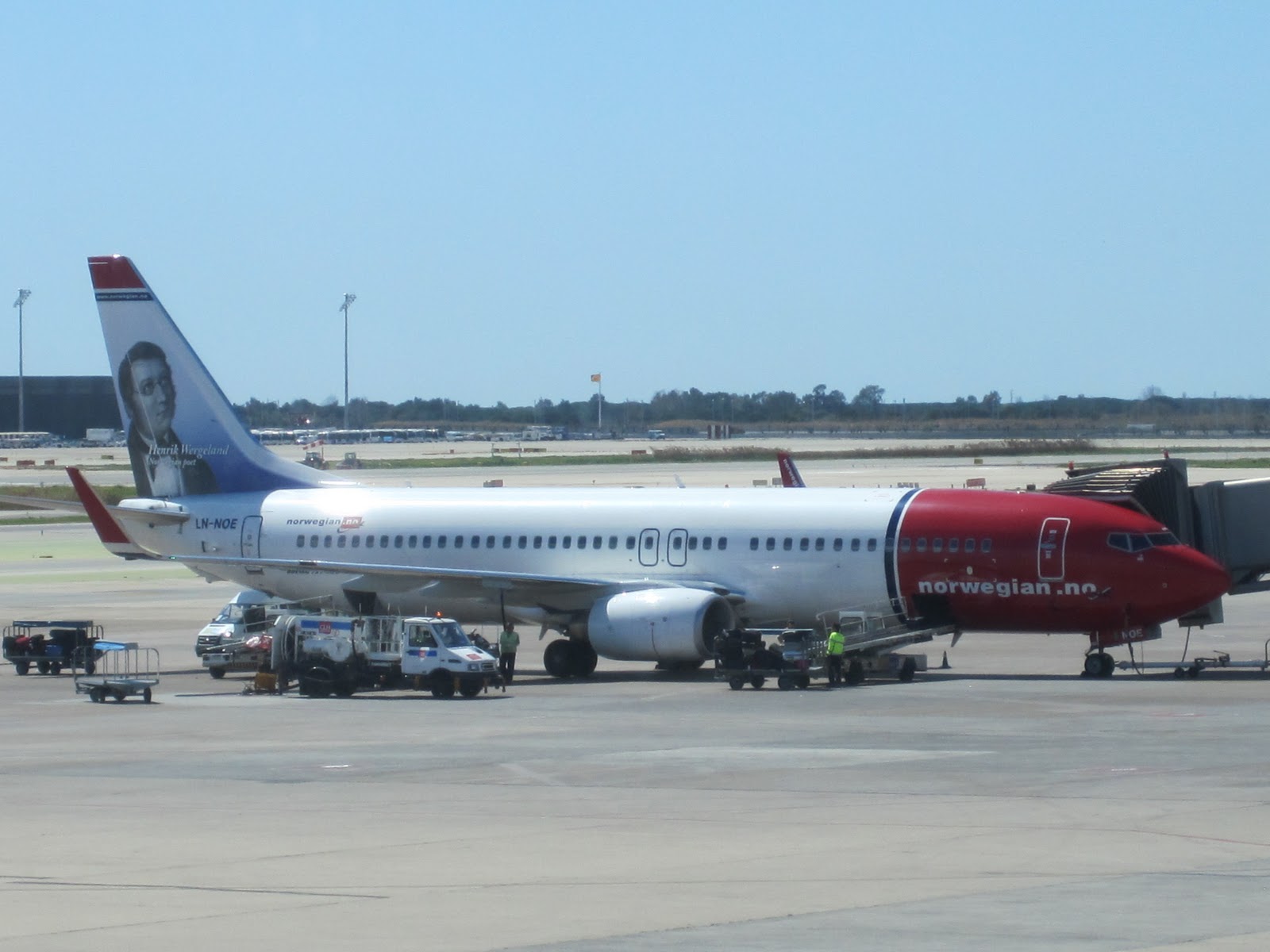
Norwegian plans to go long-haul as soon as it gets its new Boeing 787s
And we are starting to see some movement among European airlines too, with Norwegian leading the way, and XL Airways in France are also pondering whether to make the move (Air Berlin is also offering long haul but I would count them more as a hybrid airline rather than low cost). Delays in the production of the Boeing 787 might be delaying some long haul plans (its, in theory, superior economics might help overcome some of the obstacles mentioned above), but looks like the long haul low cost carrier is coming soon to an airport near you!
Thursday, 22 December 2011
Are European airlines becoming like football clubs?

This week we have got confirmation of the acquisition of a significant equity stake in Air Berlin by Eithad. The Abu Dhabi carrier will increase its stake to over 29% from the 2.99% it already owned, this will make it the first shareholder in Germany's second largest carrier.
What's interesting in this deal, though, it's not only that this is the first major foray by one of the emerging Gulf carriers in the European airline industry, although maybe not the last if we listen to the rumors coming out of Ireland, but the fact that this investment will have consequences that go beyond the financial sphere. And this raises important questions regarding the industry's competitive landscape.
As this CAPA thorough analysis underlines, Air Berlin and Etihad are going to be, from now on, close partners: financially, as Etihad is injecting €255M in Air Berlin to help finance its fleet renewal and expansion, and also operationally, as Etihad and the airlines in Air Berlin group (including Austria's Niki and Switzerlands Belair) are going to codeshare routes across their networks. Air Berlin has already announced that is moving its Dubai service to Abu Dhabi to take advantage of the enhanced connectivity that its new partner provides. We can expect Etihad to benefit as well from Air Berlin's European network at the other end of the route.

What this means, in effect, is that Lufthansa's long haul operation is going to be facing a larger passenger drain towards the emerging Gulf hub. Plus Air Berlin-Etihad have also the opportunity to develop an alternative German hub at Berlin's new airport, possibly not a coincidence that, in what looks like a preventive move, Lufthansa has recently announced plans to create a base in the German capital, an airport where it had had a very limited presence so far. It remains unclear whether this situation is going to affect Air Berlin's recent membership of Oneworld.
And it is precisely Oneworld who could be facing a similar situation in one of its home markets if Qatar Airways acquisition of Spanair is finally confirmed. As I write these lines the outcome of this negotiation is uncertain, although a deal must be closed soon as Spanair seems to be running out of cash. As I mentioned a few days ago, Qatar Airways would have its European beachhead, and, as in Berlin's case, it would be able to use a large brand-new airport with plenty of spare capacity to expand its European feeder operation.
Most important, and hence the title of this post, getting new entrants with access to a seemingly unlimited amounts of capital could significantly alter the competitive landscape (or distort it, depending on how you look at it)...which makes me think doesn't all this seem resemble what has happened with that other glamorous but chronically loss-making European industry:...football?
Saturday, 27 November 2010
A tour of Spain's empty airports: Ciudad Real (I)

Life's hard for Spanish regional airports...no subsidy, no Ryanair...
Spain has been hard-hit by the current economic crisis. One of the ills of Spain is its oversized construction sector, that flourished at a time when Spain was building more houses in a year than the rest of Western Europe put together, or more kilometers of high speed rail than Japan. And the airport sector was not immune to this fever. A number of airports were built under the assumption that the good years would never end and that ever-growing low-cost airlines would fill their facilities and bring prosperity to their hinterlands.
In a number of posts I will examine the legacy of that the boom years have left at Spain’s airports network, how airports that to this date remain devoid of flights are coping with the effects of the economic crisis, what is their current situation and what are the perspectives for the future.
It must be said that part of the growth was for real. A number of factors explain why it was necessary to invest in better infrastructure: first of all an upgrade was necessary after decades of backwardness compared to the rest of Europe, add to that a booming and increasingly internationalized economy, a growing and more diverse population and a continuing flow of tourists taking advantage of the low cost airline revolution.
But in the midst of this growth some companies and local authorities started devising ambitious plans, some have proven to be too ambitious...one of them is Ciudad Real airport, also called Don Quijote airport(CQM), named after the legendary 17th Century Cervantes' masterpiece,that is set in the region.
The scheme was simple and executed on a grand-scale (investment is thought to have been around €1.1B): to build a brand-new airport next to the high-speed railway line Madrid-Seville and market it as "Madrid-South".
This was the first dubious assumption. Ciudad Real airport is 250km. from Madrid, the main market it was intending to serve. This is a bit far, even for Ryanair standards!
No problem, the airport developers argued, we are next to the high speed train so why not just build a station and get people to complete their journey by train? Ok, some problems with this: are you expecting low cost passengers, that are supposed to account for the major share of traffic, to step off their cheap flights and then pay the not particularly cheap high-speed rail tickets for the hour-long trip to Madrid? (another key factor in such a set-up is train frequencies, that at the time of writing this post remained an enigma, but my guess is that they would be unlikely to reach the sort of frequency that air travellers would expect of a commuter service). It might work for some passengers but I think this would not be very sustainable solution to support the levels of traffic that would make CQM economically viable (the airport has the capacity to handle 10M. passengers a year). If you opt for road transport, the ride can take you nearly two hours, which is more that the flying time to Ciudad Real airport from most European destinations. Take away the Madrid link and there is little economic or tourist activity in this sparsely populated area to support an airport of its own.
You might say that, luckily for Spain’s wretched public coffers, this was a private initiative (the first private airport to open in Spain). But this is just part of the story: one of the airport's main shareholders was the semi-public local savings bank, Caja Castilla-la-Mancha (CCM), that owned 30% of the venture, and that subsequently had to file for bankruptcy and be rescued by the Spanish government. Plus do not expect the local authorities to allow the airport to close down without first trying to keep it alive with generous public subsidies.
Four different airlines have opened routes from Ciudad Real. The first two to try it, Air Berlin and Air Nostrum, have already left. Ryanair departed shortly after, since it could not reach a satisfactory agreement (aka generous enough subsidies) to continue operating. Only Vueling is left, operating a heavily subsidised operation(something AirObserver noted a few weeks ago). I prefer not to think what the cost/passenger is (at some point this year there were 91 full-times employees taking care of the passengers of a single Ryanair thrice-weekly flight, which forced the airport company to dismiss part of the workforce). Prospects to get more traffic look grim.
Is there a future?
It will be very difficult for Ciudad Real airport to achieve, in the foreseeable future, the levels of activity it has been designed for, even if the economy rebounds and the Madrid metro area goes back to previous growth levels. Even more when there is still plenty of capacity left at MAD and plans for a new airport to the South of Madrid are already under way.
Another option that might have more chances of becoming economically viable is to become a cargo airport. Ciudad Real has a central location in the Iberian peninsula, an extra-long runway and plenty of land around it, the sort of space that could facilitate the development of a large scale intermodal logisitcs operation.
But the idea of developing a large logistics hub from scratch remains no less of challenge...! .
Subscribe to:
Posts (Atom)


