Showing posts with label BCN. Show all posts
Friday, 2 November 2012
The shortest commercial flight I've ever made
It was last week, courtesy of Easyjet...
When our flight from London Gatwick was about to land at Barcelona-El Prat, the pilot went on air to say that the runway where we were expecting to land had been temporarily closed and that, in view of the fact that we only had fuel for 20 more minutes of flight, we were diverting to Reus airport, 100 miles south of Barcelona, in order to refuel.
And so we did. The interesting part is that we then were to fly from Reus to Barcelona. I had flown short flights in general aviation aircraft before, but this is ceertainly the shortest distance I have flown in a commercial jet aircraft: it took about 15 minutes for the Easyjet A319 to cover the 100 miles that separate Reus and Barcelona airports...
Some curiosities from this experience:
-Upon arrival I noticed that our flight appeared twice on Barcelona airports flight information displays in the arrivals area and both with the same flight number: one for the original one from Gatwick and another one listed as coming from Reus.
-We could enjoy the safety instructions demonstration twice (even if no one exited the aircraft). I know this is standard practice but I found ita bit surreal.
-We were at Reus for longer than expected because the flight plan had to be provided to the pilots in paper and it seems there was no one ready to print it out at that time of the night at Reus airport (which is quite a small airport that gets only a handful of Ryanair flights at this time of the year). I guess this situation will not be hapenning a few years from now, when everyone is using iPads (I ignore if some regulations will need to change to adapt to the new paperless reality too).
This was my shortest commercial flight so far, but might not be the last, I know there are some scheduled flights out there that are even shorter than this, in the Caribbean and also in places like the Orkney Islands, that hold the record to the shortest regular commercial flight in the World!
Tuesday, 16 October 2012
Vueling keeps growing, plans to fly to a 100 cities from Barcelona
More like this coming soon!
There was quite a lot of expectation today to hear what Vueling had to announce.
And there were interesting novelties, as Vueling continues to upgrade its product with the introduction of a business class. One step that was anticipated as it fits into the carrier's strategy to target business travellers. So, this announcement did not really come as a surprise, as I had already pointed out in these pages how there were objective measures to qualify Vueling as a hybrid airline rather than a low cost carrier and the airline's top managers had already provided some hints about the imminence of this move.
Regarding fleet renewal and expansion programme Vueling will be getting some 9 brand-new aircraft of the A320 family shortly (at the moment is still flying some Iberia-then-Clickair 1990s-vintage A320s) and some of them will be equipped with wi-fi. The first (unanswered) question that comes to my mind is whether this means the end of Vueling's flirtation with Bombardier's CSeries...
Another important novelty is the massive route expansion out of Barcelona and into Europe and Africa. The new twice daily service between Barcelona and London Gatwick really stands out, because until now Vueling had avoided head-to-head competition on this route with Easyjet and Ryanair. Also of note is the airline'e first foray into sub-saharan Africa, where it is "taking over" the niche route to Banjul, that used to be operated quite successfully by now-defunct rival Spanair. New routes to Morocco reinforce the growing presence of Vueling in Africa, that I commented already a few months ago. 28 new routes in total for the summer season (you can find the list here) that will bring to 100 the number of direct destinations operated by Vueling from Barcelona.
In another example of the company's hybridisation, Vueling's CEO Alex Cruz said that he aims to make of Barcelona one of Europe's top hubs (I guess he was referring to intra-European connections, since there are still few long-haul flights at Barcelona that Vueling's passengers can connect too). In order to support this claim he revealed that transit passengers already make 20% of total traffic (not a bad number for a company that was not initially conceived as a hub-and-spoke network carrier!).
The hub-in-the-Med possibility that I outlined nearly two years ago might finally come to fruition after all...
Monday, 10 September 2012
IAG's Spanish problem, Iberia Express and Vueling
And what now seems inevitable is that Iberia's short and medium haul network will be progressively taken over by Iberia Express, the vehicle that IAG has chosen to get rid of the existing labour relations framework at Iberia. For Iberia's customers the change to Iberia Express should not be a big change...for now...because, Iberia Express might have been helpful in taming some structural cost issues within the company (Iberia Express is already profitable), however, it can do little against the huge exogenous pressures currently affecting the Spanish air travel market, like the deep economic crisis and the strong competition from other low cost carriers (among the major European markets, is possibly the one where LCCs enjoy a larger marjet share).
So it is not unlikely that, while keeping some network carrier features, most important of all, feeding Iberia's long-haul network, or what's left of it, Iberia Express, and the rest of the airline, might have to undergo a process of "low-costization".
Curiosly enough Iberia is the major shareholder of another Spanish low cost, and one that is profitable: Vueling. The Barcelona-based carrier is actually on an opposite path: whereas Iberia might end up trading-down, Vueling is trading-up and offering more and more extras to its passengers, in a drive to attract business customers.
Will Vueling and Iberia (Express) end up occupying the same market space?
If this happens, will the two brands be kept? In theory, there is no need to, despite its shareholding Vueling is an independent company and it has its hub at Barcelona, whereas Iberia Express is based at Madrid. However, it is not unthinkable that Vueling becomes more operationally entangled with Oneworld's operations in Spain as it starts to codeshare more and more, take on feeding operations, etc. Will there be a temptation to consolidate Vueling and what's left of Iberia in a big low cost operation? Who would then have the strongest brand? and right structure and "mind-set" to operate as a low cost? an strengthened Vueling or a "downgraded" Iberia?
Of course, the most likely outcome is that nothing of this might actually end up happening, but "what if" scenarios are always entertaining...
Tuesday, 19 June 2012
Vueling's CEO outlines some key points about the future of the airline
Mr.Cruz speaking. The event was chaired by renowned historian Paul Preston (foreground)
A few days ago I had the chance to attend a presentation by Vueling's CEO, Alex Cruz, at the London School of Economics (organized by the Spanish Chamber of Commerce of Great Britain and LSE Enterprise). It's been a few days already (traveling and other work have prevented me from posting more often lately!) but I guess most of what he says remains valid.
Here are some of the points he touched:
-Vueling has a really competitive cost structure, at a unit cost per ask of €4.18 it compares favourably to Easyjet's €4.36, and even better with regards to other competitors such as Air Berlin, although still some way off cost-leader Ryanair, at €2.22.
-Vueling is unique among low cost carriers in that it participates in two frequent flier programmes: its own, Punto, and IAG's Avios.
-Mr. Cruz explained how when they set up Clickair, an Iberia subsidiary that later merged with Vueling, they followed the textbook examples (Ryanair) of what a low cost carrier should do and should not do, but after some time in the business they started challenging some of this "established" knowledge and experiment with things such as assigned seats or connecting flights, that have yielded satisfactory results so far.
-Vueling is continuing to pursue its hybridisation strategy, with the aim of attracting business customers (the recently launched Vueling Pass goes in this direction)
-They aim to strengthen cooperation with other carriers within Oneworld, such as BA and LAN, to support its growing, although still small, connecting traffic via its Barcelona base.
-Regarding network, and asked by the audience about the long-haul plans some airlines have announced (for example, Norwegian) Mr. Cruz stated that their intention is to continue flying only to cities that are no more than a 4-hour flight away from Barcelona (they do not like hotel expenses!). He still sees new opportunities within this geography, though, for example in Eastern Europe and Russia, maybe even some destinations in Africa.
-Regarding fleet, the aim is to reach 100 aircraft as quickly as possible, since this would provide the scale required to remain competitive. Vueling is likely to remain a single aircraft-type operator for now, although they have considered different options, including Boeing and Bombardier.
-To conclude, one thing that keeps him awake: the risk of the company growing to the point that it loses its personality, its dynamism and freshness...
Still some way to go, I think....
Sunday, 17 June 2012
Barcelona airport to open a beach club
Customers are expected to benefit from increased market competition, this is evident when it comes to airlines (despite some missing the "golden age" of aviation where hardly anyone could afford to fly), but what about airports?
Airports do compete too and one of the ways to do so is trying to provide the best passenger experience. In this blog I have already expressed my preference for Amsterdam Schiphol (and I have not even tried the amphibious vehicle tour or the virtual butterfly garden), but now another airport I know well is entering the fray: Barcelona airport has just unveiled plans to build a golf course and...a beach club!
The story caught my attention, maybe because I have just come back from a trip to Bergen, Norway, where, taking advantage of the airport location (see picture below) and of the amazing spell of warm weather (yes, it can be warm and sunny in Norway too!)
I managed to have a bath in the sea while awaiting my flight. I must say it was not an easy task to find a spot with open access to the sea since most of the seafront is taken up by private houses with gardens, but, hey!...here is where I got...(and yes, it feels great to swim a bit before your flight!)
I am sure being able to spend some time on the beach before boarding your flight home at BCN, could prove popular with the millions of tourists that use the airport every year (although the Catalan capital is not a "pure" beach and sand destination, it is not unusual to find people wearing little more than sandals and shorts on flights to BCN during the summer season!)
Sources at the airport confirmed that the idea is to have a private company run both facilities, the golf and beach club, that will be located on airport-owned land next to the terminals, although not physically connected to it (so some sort of shuttle service would need to be set up too) and, both the beach club and the golf club are also going to be open to the general public, not only airport users.
The beach club might be ready for next year's summer season, while the golf course is expected to be completed by 2014. In a way, it is a sort of "come-back" since there was already a golf club years ago (it was actually the oldest in Catalonia) in the space where now the sea-side airport runway is located.
This is also a perfect example of an airport embracing the idea of treating passengers, not only airlines, as "clients" and making of the airport not just a transit point but an enjoyable part of the whole travel experience.
I can think of some other airports next to the sea...who will be next?
Airports do compete too and one of the ways to do so is trying to provide the best passenger experience. In this blog I have already expressed my preference for Amsterdam Schiphol (and I have not even tried the amphibious vehicle tour or the virtual butterfly garden), but now another airport I know well is entering the fray: Barcelona airport has just unveiled plans to build a golf course and...a beach club!
The story caught my attention, maybe because I have just come back from a trip to Bergen, Norway, where, taking advantage of the airport location (see picture below) and of the amazing spell of warm weather (yes, it can be warm and sunny in Norway too!)
My favourite bathing spot on the far side of the runway!
I managed to have a bath in the sea while awaiting my flight. I must say it was not an easy task to find a spot with open access to the sea since most of the seafront is taken up by private houses with gardens, but, hey!...here is where I got...(and yes, it feels great to swim a bit before your flight!)
I am sure being able to spend some time on the beach before boarding your flight home at BCN, could prove popular with the millions of tourists that use the airport every year (although the Catalan capital is not a "pure" beach and sand destination, it is not unusual to find people wearing little more than sandals and shorts on flights to BCN during the summer season!)
Sources at the airport confirmed that the idea is to have a private company run both facilities, the golf and beach club, that will be located on airport-owned land next to the terminals, although not physically connected to it (so some sort of shuttle service would need to be set up too) and, both the beach club and the golf club are also going to be open to the general public, not only airport users.
Making the best out of location!
The beach club might be ready for next year's summer season, while the golf course is expected to be completed by 2014. In a way, it is a sort of "come-back" since there was already a golf club years ago (it was actually the oldest in Catalonia) in the space where now the sea-side airport runway is located.
This is also a perfect example of an airport embracing the idea of treating passengers, not only airlines, as "clients" and making of the airport not just a transit point but an enjoyable part of the whole travel experience.
I can think of some other airports next to the sea...who will be next?
Labels:
airport marketing,
Airports,
apex,
Barcelona,
BCN,
Bergen,
Marketing,
passenger experience
Saturday, 14 April 2012
Is Vueling getting ready for an African adventure?
Ready to fly South
One of the consequences of Spanair's demise was that Barcelona airport lost some niche African routes, such as Banjul (The Gambia) and Bamako (Mali) that were only operated by the bankrupt carrier.
While these routes never carried a large number of passengers, they were strategically important for Barcelona airport, that, lacking a traditional flag carrier, has long been struggling to find its place among European hubs. Africa's developing air travel market might provide some opportunities for Barcelona to develop its long-haul network. Over 560,000 passengers flew between Africa and Barcelona last year, around 60% of these on Moroccan routes, however these numbers are only a small fraction of the 30 million passengers that passed through Barcelona-El Prat (BCN).
According to Spanish business daily Expansion, quoting sources of the CDRA, Barcelona's route development organisation, nearly 25,000 passengers flew on the Banjul route last year and almost 15,000 on the Bamako one, with both routes showing robust growth. The CDRA has also identified Dakar as a potential viable route from Barcelona, since 24,000 passengers currently fly between the two cities annually through indirect routes.
If we are to give credit to some reports, Vueling might be seriously considering stepping in. Those are certainly challenging markets, but the absence of competition means that airlines can get higher yields on their African routes. This fact and growing economies all over the continent, despite current political instability in part of the Sahel, means that airlines from all over the World have turned their attention to the once-neglected African market.
It would be logical that Barcelona's home airline had a go at it. The Catalan airport, in turn, would also benefit from leveraging its advantageous geographical position to become a connection point between Europe and Africa.
Tuesday, 31 January 2012
A tribute to Spanair, in pictures...
I travel often through Spanish airports, where Spanair aircraft were a common sight. They came in different sizes and colours, the result of a convulse corporate history. Spanair, we will miss you!
Here is my photo-tribute:
The old livery, here a Spanair Airbus at Madrid-Barajas
And the new livery...this one spotted at BCN
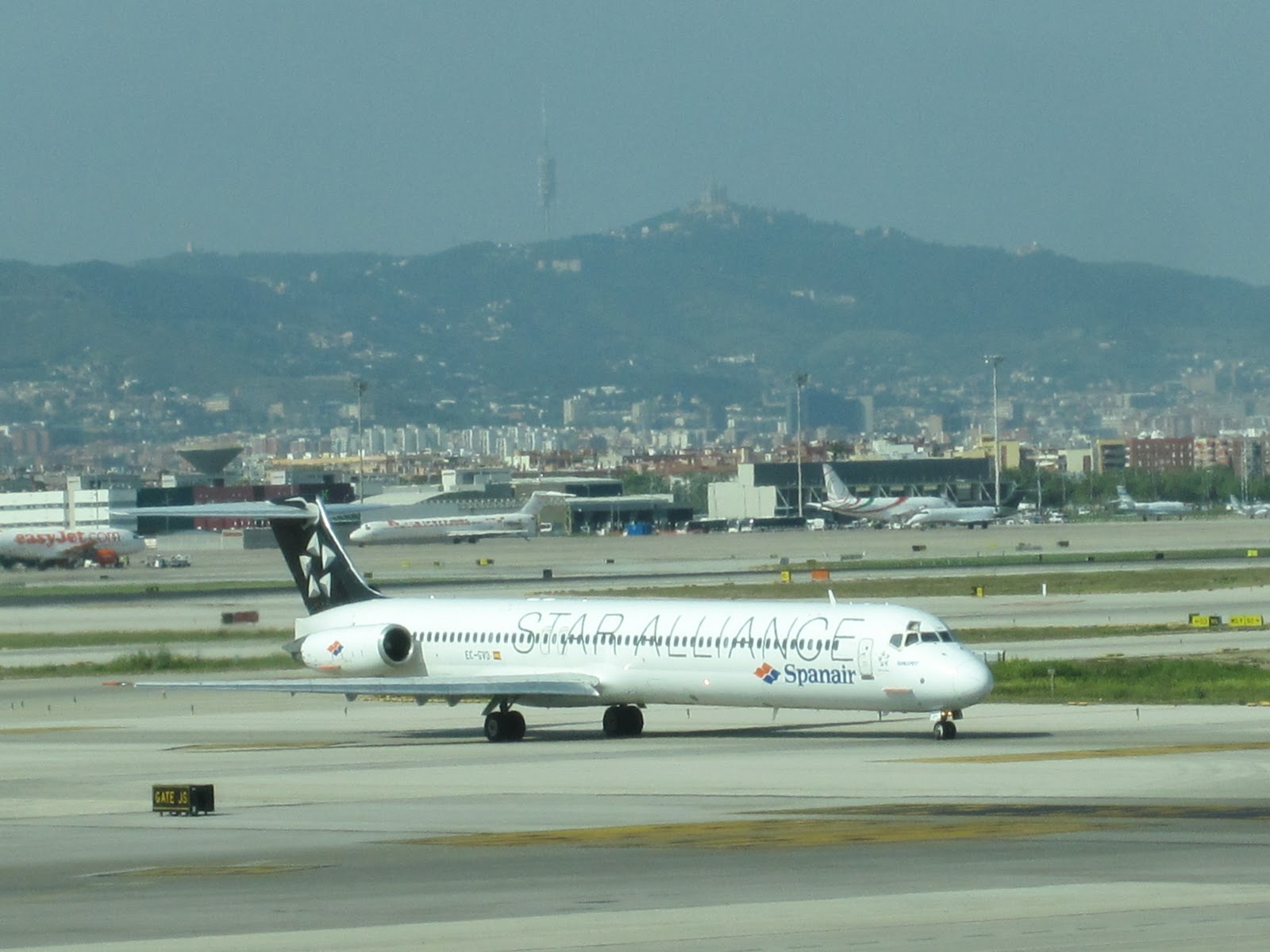
Spanair was a proud Star Alliance partner
A Boeing 717, we'll see some more of these in the European skies soon!
Spanair was positioning itself as "the Barcelona airline": here a map of its network in a commercial advert
A Spanair MD-83 with the city of Barcelona in the background
Spanair EC-GVO taxiing at BCN
Spanair's fleet was initially made of MD-83s, some of these have remained with the carrier until the end
The old and new liveries side by side at BCN
Despite management efforts, the outlook had always been really foggy for Spanair...
Labels:
Airbus,
BCN,
Boeing 717,
Madrid,
MD-83,
Planespotting,
Spanair
Monday, 30 January 2012
Spanair's collapse: a few notes
When I wrote my latest post a few days ago, I was not expecting to write again so soon about the Spanish aviation industry, but the events of last Friday, despite not being entirely unexpected, have shaken to the core the Spanish airline industry, nothing less than the collapse of Spanair.
I have been following the Spanair saga almost since the day I started this blog and a lot has been said already about Spanair's demise (the Spanish and, particularly, the Catalan press are packed with news, reports and comments about the Spanair case), so this won't be a long post...
The fact is that Spanair was fighting an uphill battle from the very start (by "start" I refer to the date when Spanair was acquired and re-founded by a consortium of government-back Catalan institutions after its near bankruptcy in 2008):
1) When it was acquired by its current owners, Spanair was already in a difficult financial situation and under-capitalized
2) The financial crisis has hit very hard its main markets
3) It was a not-particularly-efficient airline that had to face formidable competitors such as Vueling and Ryanair at its own home base
4) It lacked any significant source of differentiation, it was neither strong enough to develop a viable network or superior service, nor efficient enough to deliver value, plus it lacked a strong brand.
5) It was acquired with government-backed funds because it was expected to help in the development of a long-haul hub at Barcelona airport, a mission that it was totally uncapable to fulfil since it lacked the fleet or the feeder routes to do it. Governments and business do not usually mix very well, but it becomes even more difficult to justify such support when there aren't any tangible results in the form of a greater return to the overall economy and the government itself is going through a round of public spending cuts.
Then there is Spanair's membership of Star Alliance: there was the expectation, that, if not alone, at least with the support of its partners, Spanair would be able to consolidate some sort of hub at BCN, while giving Star Alliance a solid foothold in South-Western Europe.
None of this is going to happen, no Qatar Airways last minute rescue either, although judging by Vueling's quick reaction, I think this supply shock will be quickly absorbed by other carriers (I have written already about the adaptability and resilience of air travel markets).
Vueling is, indeed, the airline that benefits the most from Spanair's demise and emerges from this situation undisputedly as Barcelona's home airline, with an expanding network and a product that has been evolving from the pure low-cost model to that of an hybrid carrier, able to appeal to both business and leisure passengers.
Saturday, 14 January 2012
The Spanish airline industry, in a state of flux
A constant flow of news is coming out of the Spanish airline industry, making it one of the hotspots of the industry in Europe, so I thought about writing this post to summarize what is going on...
One of the most amazing things is that the deep economic crisis that Spain is currently going thorugh is not enough to deter Spanish airline entrepreneurs...one of the most exciting developments we have seen in last few months is the set-up of "stealthy" Barcelona-based airline startup, Volotea. Little is known about this project so far, except the identity of the founders, the fact that it is going to operate in the short-haul market and that its fleet is going to be composed of Boeing 717s. All these details, that were already advanced in the post I wrote a few weeks ago, have now been confirmed. Some reports in the press pointed also to the fact that it might not restrict its operations to the Spanish market only.
This is certainly an interesting timing to get into Spain's regional market, as the main incumbent in this segment, Air Nostrum is grounding up to 15 aircraft, reducing the number of staff and considering to move its headquarters from crisis-hit Valencia, on the Mediterranean coast, to the Basque city of Bilbao.
At the same time Vueling has announced an investment of €325 million and a major expansion at its Barcelona base, with 5 new Airbus A320 based there and the launch of 23 new routes. This will bring Vueling's total number of cities served from Barcelona to 70, which makes it one of the largest short-haul networks in Europe.
Air Nostrum operates many regional routes within Spain on behalf of Iberia
At the same time Vueling has announced an investment of €325 million and a major expansion at its Barcelona base, with 5 new Airbus A320 based there and the launch of 23 new routes. This will bring Vueling's total number of cities served from Barcelona to 70, which makes it one of the largest short-haul networks in Europe.
Vueling's recent network expansion strategy is also worth of note, not only from a quantitative but also from a qualitative point of view...I wrote not long ago about how Barcelona could fulfill its hub ambitions by having an airline develop a network linking it to second and third-tier cities around the Western Mediterranean. The aim would be to become the reference hub for this region, in a way similar to what KLM does with its links between Amsterdam and British and Scandinavian regional airports. When I wrote this what I had in mind was more of a regional type of operation (as KLM does) and I still have serious doubts about whether the Airbus A320 is the right aircraft for this type of operation based on thin routes, but Vueling's route map, particularly in France, with additions such as Bordeaux, Lourdes, Marseille, Nantes and Brest, and Italy, with Genoa, Pisa, Verona,...plus its new "connection flight" service seem to fit well with this strategy. Whether this will ultimately lead to the materialization of the much-awaited long-haul hub at Barcelona remains to be seen...
It is also noteworthy that Vueling is finally launching its first UK routes out of Barcelona (it flies already between the UK and several Spanish regional airports), a territory that, until now seemed reserved to the likes of Easyjet and Ryanair (by the way, the Irish airline has finally closed a deal with the Catalan government that will provide for 19 routes being launched or reinstated at Girona airport (GRO), just one hour drive North of Barcelona, BCN).
In the meantime, Barcelona's other carrier, Spanair, is languishing while awaiting its possible acquisition by Qatar Airways. Senior officials from the Catalan government and Barcelona City Council flew to Doha a few days ago to discuss the sale of Spanair to the Gulf carrier. As pointed out in this post, it will be interesting to see how petro-dollars affect the competitive landscape in the European airline industry. These negotiations, however, have not been obstacle for Qatar Airways to cooperate closely with Spanair's rival Iberia, to the point that it will be the only non-Oneworld airline to use Madrid's gigantic T4 terminal. Qatar Airways' passengers will also be able to use Iberia's domestic network for onward flight connections.
And I finish this post, precisely, with Iberia, as it is preparing the launch of its new low-cost airline Iberia Express. In reality, I think this move will be hardly noticeable to the average passenger: Iberia Express will be using the same aircraft and fly the same routes that Iberia already does, plus it will also offer business class. Iberia's on-board service on short-haul economy is already barely different to that of low cost airlines so not much of a change here either. So Iberia Express is more of a way to end a bitter labour dispute and lower operating costs in its short haul operations, a necessity for Iberia considering how entrenched Ryanair and Easyjet have become in the Spanish market, rather than the launch of a truly "new" airline.
Thursday, 22 December 2011
Are European airlines becoming like football clubs?
This week we have got confirmation of the acquisition of a significant equity stake in Air Berlin by Eithad. The Abu Dhabi carrier will increase its stake to over 29% from the 2.99% it already owned, this will make it the first shareholder in Germany's second largest carrier.
What's interesting in this deal, though, it's not only that this is the first major foray by one of the emerging Gulf carriers in the European airline industry, although maybe not the last if we listen to the rumors coming out of Ireland, but the fact that this investment will have consequences that go beyond the financial sphere. And this raises important questions regarding the industry's competitive landscape.
As this CAPA thorough analysis underlines, Air Berlin and Etihad are going to be, from now on, close partners: financially, as Etihad is injecting €255M in Air Berlin to help finance its fleet renewal and expansion, and also operationally, as Etihad and the airlines in Air Berlin group (including Austria's Niki and Switzerlands Belair) are going to codeshare routes across their networks. Air Berlin has already announced that is moving its Dubai service to Abu Dhabi to take advantage of the enhanced connectivity that its new partner provides. We can expect Etihad to benefit as well from Air Berlin's European network at the other end of the route.
Austria's Niki and Switzerland's Belair are also going to join forces with Eithad,a s they are part of the Air Berlin group
What this means, in effect, is that Lufthansa's long haul operation is going to be facing a larger passenger drain towards the emerging Gulf hub. Plus Air Berlin-Etihad have also the opportunity to develop an alternative German hub at Berlin's new airport, possibly not a coincidence that, in what looks like a preventive move, Lufthansa has recently announced plans to create a base in the German capital, an airport where it had had a very limited presence so far. It remains unclear whether this situation is going to affect Air Berlin's recent membership of Oneworld.
And it is precisely Oneworld who could be facing a similar situation in one of its home markets if Qatar Airways acquisition of Spanair is finally confirmed. As I write these lines the outcome of this negotiation is uncertain, although a deal must be closed soon as Spanair seems to be running out of cash. As I mentioned a few days ago, Qatar Airways would have its European beachhead, and, as in Berlin's case, it would be able to use a large brand-new airport with plenty of spare capacity to expand its European feeder operation.
Most important, and hence the title of this post, getting new entrants with access to a seemingly unlimited amounts of capital could significantly alter the competitive landscape (or distort it, depending on how you look at it)...which makes me think doesn't all this seem resemble what has happened with that other glamorous but chronically loss-making European industry:...football?
Labels:
acquisitions,
Aer Lingus,
Air Berlin,
BCN,
BER,
Berlin,
Etihad,
Germany,
Qatar Airways,
Spanair
Friday, 15 April 2011
Vueling and Spanair: two different strategies to develop Barcelona into an airline hub
A few weeks ago I presented my vision of Barcelona airport as at potential Mediterranean hub. But are there any airlines able to turn this idea into a reality?
Actually, the chances of this happening, although small, have never been better, as there are currently two airlines aiming to develop a hub-style operation at BCN: Vueling and Spanair, however each of them has its particularities.

Spanair MD-83 EC-GVO with the city of Barcelona in the background
On one hand, Vueling started as a pure low cost play, although its model has been going through an hybridisation process that has seen it progressively adding more of the features of a network airline. On the other hand, Spanair's troubled existence as a conventional full-service airline, took a radical turn when a group of investors supported by the Catalan government purchased it with the mandate to develop an international hub out of Barcelona.
Spanair is actively marketing itself as "Barcelona's carrier", the only one able to take Barcelona to the first division of European airports. Spanair's latest marketing campaign, Jo Crec en Barcelona (which means "I believe in Barcelona" in Catalan language) goes in this direction. But how does this translate in terms of network development?
Until now most of Spanair's growth, which has been constrained by the carrier's delicate financial situation, has been aimed at leveraging its Star Alliance links, new routes and frequencies between Barcelona and Germany and code-sharing with Singapore Airlines, as well as developing some niche markets out of Barcelona with routes to North Africa and the Sahel (Algiers, Nador, Banjul, Bamako and the, now abandoned, Tripoli). This niche market strategy would fit well with the concept of a Star Alliance South-Western European hub, by offering a diversified and unique route network and channeling traffic through Barcelona, however, given Spanair's weak European network outside Germany, it remains unclear to me what traffic is going to feed these specialty routes other than a limited domestic Spanish demand and some spillovers from Star Alliance's main hubs in Central Europe.
In my post about the Mediterranean strategy I pointed at the need to achieve some critical mass by linking those cities that are within easy reach from Barcelona and are somehow underserved buy their own flag carriers. And this is what Vueling seems to be doing. This airline, partly owned by Iberia, is strengthening its network by opening routes from Barcelona to a number of airports in Southern France (Bordeaux, Toulouse) and Italy (Genoa, Pisa) in addition to a very strong Spanish and European network, at the same time it is enabling connections between different flights and feeding Iberia's new transatlantic services at Barcelona (to Miami and Sao Paulo). Does this mean the hub status for Barcelona is getting closer? yes and no, in a way the seeds of a potential Mediterranean hub are being planted, but at the same time, Barcelona is still far from enjoying the sort of coordinated waves of arrivals and departures, network reach and feeder frequencies that even secondary hubs have.

Vueling A320-200, EC-ICS, landing at BCN
Another question is whether is there enough space at BCN for two airlines aiming to make it its hub, particularly when factoring in the increasing competition from Ryanair...maybe developing a hub would require combining Vueling's European reach with Spanair's niche network...but this is another story!
Actually, the chances of this happening, although small, have never been better, as there are currently two airlines aiming to develop a hub-style operation at BCN: Vueling and Spanair, however each of them has its particularities.
Spanair MD-83 EC-GVO with the city of Barcelona in the background
On one hand, Vueling started as a pure low cost play, although its model has been going through an hybridisation process that has seen it progressively adding more of the features of a network airline. On the other hand, Spanair's troubled existence as a conventional full-service airline, took a radical turn when a group of investors supported by the Catalan government purchased it with the mandate to develop an international hub out of Barcelona.
Spanair is actively marketing itself as "Barcelona's carrier", the only one able to take Barcelona to the first division of European airports. Spanair's latest marketing campaign, Jo Crec en Barcelona (which means "I believe in Barcelona" in Catalan language) goes in this direction. But how does this translate in terms of network development?
Until now most of Spanair's growth, which has been constrained by the carrier's delicate financial situation, has been aimed at leveraging its Star Alliance links, new routes and frequencies between Barcelona and Germany and code-sharing with Singapore Airlines, as well as developing some niche markets out of Barcelona with routes to North Africa and the Sahel (Algiers, Nador, Banjul, Bamako and the, now abandoned, Tripoli). This niche market strategy would fit well with the concept of a Star Alliance South-Western European hub, by offering a diversified and unique route network and channeling traffic through Barcelona, however, given Spanair's weak European network outside Germany, it remains unclear to me what traffic is going to feed these specialty routes other than a limited domestic Spanish demand and some spillovers from Star Alliance's main hubs in Central Europe.
In my post about the Mediterranean strategy I pointed at the need to achieve some critical mass by linking those cities that are within easy reach from Barcelona and are somehow underserved buy their own flag carriers. And this is what Vueling seems to be doing. This airline, partly owned by Iberia, is strengthening its network by opening routes from Barcelona to a number of airports in Southern France (Bordeaux, Toulouse) and Italy (Genoa, Pisa) in addition to a very strong Spanish and European network, at the same time it is enabling connections between different flights and feeding Iberia's new transatlantic services at Barcelona (to Miami and Sao Paulo). Does this mean the hub status for Barcelona is getting closer? yes and no, in a way the seeds of a potential Mediterranean hub are being planted, but at the same time, Barcelona is still far from enjoying the sort of coordinated waves of arrivals and departures, network reach and feeder frequencies that even secondary hubs have.
Vueling A320-200, EC-ICS, landing at BCN
Another question is whether is there enough space at BCN for two airlines aiming to make it its hub, particularly when factoring in the increasing competition from Ryanair...maybe developing a hub would require combining Vueling's European reach with Spanair's niche network...but this is another story!
Wednesday, 2 March 2011
What next for Girona airport?
Girona has been possibly the fastest growing in Spain during the last decade. From a sleepy charter-only airport, GRO has gone on to become one of Ryanair's major bases in the continent...or was it?
In fact, GRO is now going through a delicate moment, and the responsible is none other than the same airline that helped it get out of obscurity: Ryanair. The Irish airline started operating from Barcelona last September and it has been opening new routes since then, most of Ryanair's traffic at GRO are actually originating or have as final destination the city of Barcelona, an airport that has now plenty of spare capacity for the Irish airline to grow.
Ryanair's base at Girona will go from 11 to 6 aircraft permanently-based aircraft
In a recent post at AirObserver's blog I already mentioned how its arrival to Barcelona has strengthen considerably Ryanair's bargaining power at Girona. And the Irish airline has put all this market power to work: a new agreement has supposedly been reached with the Catalan authorities, providing €7.5M to keep Ryanair at Girona until. But the recent government change in Catalonia has changed spending priorities and now is uncertain whether the agreement is going to be implemented or not.
According to some reports, Spanair is being asked by the Catalan government (that has been supporting it through direct capital injections) to take over some of the routes previously operated by Ryanair, namely the Girona-Madrid one. This move would not make any sense to me.
For a start, I doubt it would work without heavy public subsidies. Spanair already tried operating this route a few years ago and it did not work. Why should it be different this time? and if subsidies are to be paid, why then all the fuss about paying them to Ryanair? the Irish airline was at least capable of bringing to Girona a volume of traffic that no one else in the industry can match.
But if we then look at the relationship between Spanair and Catalan public institutions we have that public money has been used to support this ailing airline on the grounds that it intends to develop a hub-and-spoke operation at Barcelona El Prat (BCN) that might, in the long run, make of BCN a major European airport. Making Spanair fill the gap at Girona while Ryanair is itself increasing its presence at BCN would be a total departure from this strategy!
This situation might be mitigated if Girona airport had the autonomy to set its own fees and pursue a more aggresive commercial policy (Mr.O'Leary himself said recently that Girona's fees were too high to compete effectively with Barcelona El Prat. If we are to judge from the fact that Ryanair is currently expanding at BCN despite not getting any subsidy) that includes actively looking for new routes and airlines.
At this point in time the only non-Ryanair regular route at GRO is Transavia's to Rotterdam. Have the airport managers any other option on the table? It would be a good idea to start looking for some...
Wednesday, 23 February 2011
Allplane quoted at AirObserver blog: commenting the new scenario at Girona airport after Ryanair's massive route cancellation
In this blog I speak often about the constantly evolving situation at Barcelona and Girona airports. It is a very interesting case of interaction, in one single metropolitan market (Barcelona-Girona-Reus) of pure low cost players (Ryanair), airlines developing an hybrid model (Vueling), an airline trying to develop a hub-and-spoke operation (Spanair), a retreating flag-carrier (Iberia) and all of this while it is becoming an emerging destination for major global carriers (Singapore Airlines, Qatar Airways, Delta Airlines).
This environment has not gone unnoticed to other European bloggers and AirObserver has just written a piece where it quotes me and presents my point of view about an hypothetic post-Ryanair Girona airport. This is a topic on which I am going to write a piece soon...In the meantime, great thanks to AirObserver for presenting my thoughts on the issue to its readers!
Labels:
BCN,
Delta,
Girona,
Iberia,
N,
Qatar Aiways,
Ryanair,
Singapore Airlines,
Spanair,
Vueling
Tuesday, 15 February 2011
A hub in the Med? What strategy should Barcelona airport follow
Barcelona airport is a sort of unusual case in Europe, it is one of the continent's top ten airports by number of passengers, however it managed to get this spot without having a flag-carrier based there and with a minimal offering of long-haul flights.
So Barcelona has been mainly a feeder market for Europe's main airlines and an important short haul destination on its own right. I have already expressed my point of view of what routes would enhance considerably the reach of Barcelona's airport but this was based on the idea of BCN becoming a spoke of other hubs. But what could be the strategy to make of BCN a hub on its own? is it feasible?
It is too late for Barcelona to become a generalist hub, it does not have the sort of legacy carrier that would make this possible. In think that any small chance of Barcelona achieving hub status depends on its ability to find a market niche and becoming incredibly good at serving it (think Finnair and its Asian strategy!).
In my opinion Barcelona should focus on becoming the gateway of the Western Mediterranean.

If you take a close look at the map you can see how Barcelona is at the centre of a Mediterranean arch that goes from North-Western Italy to South-Western Spain, the contour of its coast clearly lit, a densely populated area. Destinations such as Marseille, Nice, Turin, Genoa, Cagliari, Algiers or Alicante can all be reached within 1-1.5h from Barcelona, that itself has a large airport with plenty of capacity and considerable Origin-Destination traffic.
The hub of the Western Mediterranean?
If you have visited the city of Barcelona and strolled down the Ramblas towards the sea, you might have noticed a large medieval building at the end of this promenade. It now hosts the maritime museum, but in its time this was one of the largest civilian buildings in the World, the Royal Drassanes (Shipyards) are a vivid reminder of an age when Barcelona managed to become the main trading port of the Western half of the Mediterranean...the example might be a bit anachronistic, but that shipyard seating at the edge of the town was the medieval equivalent of today's largest air facilities... and not too far from there, some 12km. further South, now sits the largest air terminal on the Mediterranean rim. Can we reinvent Barcelona as the hub of the Mediterranean?
Let's do some SWOT analysis!
BCN has some strengths to show for:
It has some critical mass of its own (it is capable of generating a traffic of 30 million passengers a year with virtually no transit passengers) and, despite the surge of tourist numbers in the last two decades it keeps a fair number of business traffic too (just look at the visitor figures of the Mobile World Congress that is taking place in the city as I write these lines)
It has a magnificent new terminal that has added plenty of spare capacity
It has quite a good geographical position to fulfill the role of West-Med hub, with the whole Iberian Peninsula, the Southern half of France and the coastal towns of Italy and North Africa all within 1,5h. flight time.
Plus it has reasonably good (although they need to improve in some areas to reach full potential) overland connections with its hinterland, the Mediterranean coastal corridor (the big arch going from Marseille to Alicante) and the Ebro valley (that links with the interior of Spain and the Atlantic), including high-speed railways (although at the moment these do not pass through the airport). The main passenger port in the Mediterranean (with both cruise and regular shipping lines) is also next door.
Now the weaknesses:
And the first and most obvious one is...there is no local airline currently able to run the mix of long-haul, short-haul services that would make it possible to develop BCN as a hub. True, Vueling is coordinating with its part-owner Iberia in order to provide connection flights and to start feeding some long-haul flights, but there are reasons to doubt the scale of Iberia's commitment to operating long-haul flights at BCN, not least because its main hub is so close!
And Spanair has also expressed interest in the hub option (this is actually its "raison-d'etre" and the only reason the airline has managed to survive through public support) but it needs to sort out its finances first.

The outlook remains a bit foggy for Spanair
We will get back to the airlines later, because there are other weaknesses that I must mention and these are more structural.
One of them is the peripheral nature of the Mediterranean market and the fact that a large share of the traffic this area generates is related to tourism, and this is a segment where any hub-and-spoke airline would have a hard time competing with low cost carriers and charters focusing on origin/destination traffic.

But some uncertainties surround Vueling's competitive position too...
And let's not forget that all European hubs, including the most consolidated ones are currently under pressure, as the center of gravity of aviation is moving East (to the Gulf, to Turkey) and this will certainly have an effect on traffic patterns.
Moreover, whereas emerging markets in Eastern Europe are making steady economic progress, the Med remains plagued with political unstability and sluggish economic performance...
Are there opportunities? Of course!
First of all, there is currently no strong hub on the Mediterranean rim, Madrid is not far, but it has a rather transatlantic orientation, Alitalia's chronic problems and underinvestment at Italian airports have prevented Rome and Milan from taking this role and Paris is a long way up North.
I said previously that the lack of long-haul airlines is a weakness, but the fact that there are not one, but two airlines, is, actually, a great opportunity. And both have links to strong alliances, in the case of Spanair, it looks as if a Mediterranean hub would fit really well in its current network, that is strongest in Northern, Central and Eastern Europe.

The gap in Star-Alliance's network
And then we have the aircraft industry producing models that seem well suited for the sort of niche positioning that Barcelona should pursue. The Boeing 787 will improve the economics of long-haul thin routes and the next generation of regional jets, such as the Bombardier CSeries or Embraer E-Series could do the same for the short haul sectors.
There would be threats of course, as competitors would not seat idle. Iberia, Alitalia and Air France would not be happy with an hypothetic Star Alliance hub in their backyard and Vueling is already facing a tough fight with Easyjet and Ryanair in its own main base.
The high degree of political control over the Spanish air travel and airport industry (even after an eventual partial privatization), including commercial and pricing policy, slot allocation and bilateral agreements with non-EU countries, is something to be accounted for. Infrastructure management and politics often mix in Spain...
Finally, the increasing share of low cost carrier traffic, although not necessarily bad news, might have some long-term implications for BCN's aspiration to become a hub. The perception that BCN is becoming a mostly tourism-oriented low cost airport could become a reality if low cost carriers take enough market share to make routes operated by full-service network airlines unprofitable, this could result in a self-reinforcing process, whereas BCN ends up being a limited choice of carriers, limited connectivity to other major airports and an almost exclusively low cost traffic.
In any case, I admit there was a lot of wishful thinking involved in this exercise...as the goal here was just to summarize the multiple factors that can play a role in the development of a hub at Barcelona airport. But most of these are secondary factors, and whether Barcelona will become a hub or not is something that ultimately depends on the airlines that choose to operate there. And this is something I am going to write about soon...
So Barcelona has been mainly a feeder market for Europe's main airlines and an important short haul destination on its own right. I have already expressed my point of view of what routes would enhance considerably the reach of Barcelona's airport but this was based on the idea of BCN becoming a spoke of other hubs. But what could be the strategy to make of BCN a hub on its own? is it feasible?
It is too late for Barcelona to become a generalist hub, it does not have the sort of legacy carrier that would make this possible. In think that any small chance of Barcelona achieving hub status depends on its ability to find a market niche and becoming incredibly good at serving it (think Finnair and its Asian strategy!).
In my opinion Barcelona should focus on becoming the gateway of the Western Mediterranean.

If you take a close look at the map you can see how Barcelona is at the centre of a Mediterranean arch that goes from North-Western Italy to South-Western Spain, the contour of its coast clearly lit, a densely populated area. Destinations such as Marseille, Nice, Turin, Genoa, Cagliari, Algiers or Alicante can all be reached within 1-1.5h from Barcelona, that itself has a large airport with plenty of capacity and considerable Origin-Destination traffic.
The hub of the Western Mediterranean?
If you have visited the city of Barcelona and strolled down the Ramblas towards the sea, you might have noticed a large medieval building at the end of this promenade. It now hosts the maritime museum, but in its time this was one of the largest civilian buildings in the World, the Royal Drassanes (Shipyards) are a vivid reminder of an age when Barcelona managed to become the main trading port of the Western half of the Mediterranean...the example might be a bit anachronistic, but that shipyard seating at the edge of the town was the medieval equivalent of today's largest air facilities... and not too far from there, some 12km. further South, now sits the largest air terminal on the Mediterranean rim. Can we reinvent Barcelona as the hub of the Mediterranean?
Let's do some SWOT analysis!
BCN has some strengths to show for:
It has some critical mass of its own (it is capable of generating a traffic of 30 million passengers a year with virtually no transit passengers) and, despite the surge of tourist numbers in the last two decades it keeps a fair number of business traffic too (just look at the visitor figures of the Mobile World Congress that is taking place in the city as I write these lines)
It has a magnificent new terminal that has added plenty of spare capacity
It has quite a good geographical position to fulfill the role of West-Med hub, with the whole Iberian Peninsula, the Southern half of France and the coastal towns of Italy and North Africa all within 1,5h. flight time.
Plus it has reasonably good (although they need to improve in some areas to reach full potential) overland connections with its hinterland, the Mediterranean coastal corridor (the big arch going from Marseille to Alicante) and the Ebro valley (that links with the interior of Spain and the Atlantic), including high-speed railways (although at the moment these do not pass through the airport). The main passenger port in the Mediterranean (with both cruise and regular shipping lines) is also next door.
Now the weaknesses:
And the first and most obvious one is...there is no local airline currently able to run the mix of long-haul, short-haul services that would make it possible to develop BCN as a hub. True, Vueling is coordinating with its part-owner Iberia in order to provide connection flights and to start feeding some long-haul flights, but there are reasons to doubt the scale of Iberia's commitment to operating long-haul flights at BCN, not least because its main hub is so close!
And Spanair has also expressed interest in the hub option (this is actually its "raison-d'etre" and the only reason the airline has managed to survive through public support) but it needs to sort out its finances first.
The outlook remains a bit foggy for Spanair
We will get back to the airlines later, because there are other weaknesses that I must mention and these are more structural.
One of them is the peripheral nature of the Mediterranean market and the fact that a large share of the traffic this area generates is related to tourism, and this is a segment where any hub-and-spoke airline would have a hard time competing with low cost carriers and charters focusing on origin/destination traffic.
But some uncertainties surround Vueling's competitive position too...
And let's not forget that all European hubs, including the most consolidated ones are currently under pressure, as the center of gravity of aviation is moving East (to the Gulf, to Turkey) and this will certainly have an effect on traffic patterns.
Moreover, whereas emerging markets in Eastern Europe are making steady economic progress, the Med remains plagued with political unstability and sluggish economic performance...
Are there opportunities? Of course!
First of all, there is currently no strong hub on the Mediterranean rim, Madrid is not far, but it has a rather transatlantic orientation, Alitalia's chronic problems and underinvestment at Italian airports have prevented Rome and Milan from taking this role and Paris is a long way up North.
I said previously that the lack of long-haul airlines is a weakness, but the fact that there are not one, but two airlines, is, actually, a great opportunity. And both have links to strong alliances, in the case of Spanair, it looks as if a Mediterranean hub would fit really well in its current network, that is strongest in Northern, Central and Eastern Europe.

The gap in Star-Alliance's network
And then we have the aircraft industry producing models that seem well suited for the sort of niche positioning that Barcelona should pursue. The Boeing 787 will improve the economics of long-haul thin routes and the next generation of regional jets, such as the Bombardier CSeries or Embraer E-Series could do the same for the short haul sectors.
There would be threats of course, as competitors would not seat idle. Iberia, Alitalia and Air France would not be happy with an hypothetic Star Alliance hub in their backyard and Vueling is already facing a tough fight with Easyjet and Ryanair in its own main base.
The high degree of political control over the Spanish air travel and airport industry (even after an eventual partial privatization), including commercial and pricing policy, slot allocation and bilateral agreements with non-EU countries, is something to be accounted for. Infrastructure management and politics often mix in Spain...
Finally, the increasing share of low cost carrier traffic, although not necessarily bad news, might have some long-term implications for BCN's aspiration to become a hub. The perception that BCN is becoming a mostly tourism-oriented low cost airport could become a reality if low cost carriers take enough market share to make routes operated by full-service network airlines unprofitable, this could result in a self-reinforcing process, whereas BCN ends up being a limited choice of carriers, limited connectivity to other major airports and an almost exclusively low cost traffic.
In any case, I admit there was a lot of wishful thinking involved in this exercise...as the goal here was just to summarize the multiple factors that can play a role in the development of a hub at Barcelona airport. But most of these are secondary factors, and whether Barcelona will become a hub or not is something that ultimately depends on the airlines that choose to operate there. And this is something I am going to write about soon...
Labels:
BCN,
Boeing 787,
Bombardier CSeries,
Embraer E-190,
FCO,
Madrid,
NCE,
Spanair,
strategy,
Vueling
Saturday, 5 February 2011
The legendary air shuttle Barcelona-Madrid: the "Puente Aéreo"
Early morning at Madrid airport, a familiar view for many Barcelona-based passengers
If in my previous post I explained how the Spanish airport authority is using replicas of some venerable aircraft to advertise her state-of-the-art facilities and, for this post, we are not leaving Spain yet, because during my recent trip to Madrid I had the chance to experience another of Spanish aviation's legendary institutions: Iberia's "Puente Aéreo" (the Air Shuttle Barcelona-Madrid).
For those who are not aware, Barcelona-Madrid happens to be the air route with most traffic in the Europe, with nearly 3 million passengers per year and around 70 daily frequencies in each direction.
A large share of this traffic went through Iberia's "Puente Aéreo", an air-shuttle that was conceived as a commuter service, where you do not need a previous booking, you just show up at the airport and get on the next available flight. If a plane is full another one departs shortly after, with frequencies at peak hours could rival those of overground public transportation, every 15 minutes or so. The idea is to provide plenty of flexibility and short waiting times at airport.
The "Puente Aéreo" has its own brand identity and fare structure, separate from Iberia's other flights, even when they are doing the same route (around half of Iberia's frequencies on the Barcelona-Madrid route correspond to the "Puente Aéreo" service, with the rest being regular flights that require reservation.
The "Puente Aéreo" has been a sort of second home to generations of businessmen and politicians, ready to pay for all this flexibility and convenience and it is no wonder that, for years, it has been Iberia's most profitable route (in a way, the "Puente Aéreo" is to Iberia what LHR-New York is to British Airways)
However, a number of changes that have affected the competitive environment in which the "Puente Aéreo" was born and developed.
The first one was the liberalization of European skies. As soon as European skies opened up, new entrants Spanair and Air Europa decided to give it a try. The route quickly became a mainstay of Spanair, that now boasts 8 daily frequencies on the route and has branded the service with a similar name, making use of the concept of "air bridge", although for legal reasons it can not call it "Puente Aéreo", so it has "Puente a Barcelona/Pont a Madrid" instead. Next came low cost airlines, with Vueling entering the fray, it has now 11 daily frequencies. Surprisingly Easyjet chose not to compete on the route in spite of having a base in Madrid. Despite all this new competition, Iberia's market share on the Barcelona-Madrid air market remains at around 45%
The completion of the high-speed railway between Barcelona and Madrid has had a stronger effect on the route as it has emerged as a real alternative in terms of frequency and comfort for business travellers, taking half of the market on the Barcelona-Madrid corridor. It has forced Iberia to reduce capacity, maintaining frequencies but deploying smaller aircraft. However, the 600 kilometers between Barcelona and Madrid are really at the edge of what is considered to be a competitive distance range for high-speed railways and the airplane remains competitive, even for origin-destination traffic. Competitive pricing and the high volume of Catalan transit passengers at MAD have helped the airplane hold its ground on this route.
I am wondering what will happen the moment Ryanair starts flying between the two cities, it now has a base in both so it sounds like a logical next step...but I think the other airlines operating the route will feel the pinch, as they rely on a more price-conscious type of travele. My guess is that the "Puente Aereo" itself will be relatively inmune.
Labels:
A321,
Air Europa,
Air shuttle,
Airbus A320,
BCN,
High-Speed Train,
Iberia,
Madrid,
Puente Aéreo,
Spanair,
Vueling
Thursday, 13 January 2011
When a direct flight is not really a direct flight?
I was recently at Barcelona airport and something caught my attention: in all airport screens, and also in the airport guide, I could see announced some flights operated by Iberia to destinations in North and South America (New York, Bogota, Mexico...), nothing unusual if I did not know that Iberia does not currently operate long distance flights at Barcelona (it is opening BCN-GRU and BCN-MIA in March). Passengers on these flights need to change planes at Madrid, however, nothing in the flight information suggested that was a non-direct flight.

Can you tell which of these flights are really direct?
Many airlines do code-sharing on certain routes, so you might end up flying with a different company to that you have booked the flight with, but I haven't come across (yet) a case where an airline markets a non-direct route, involving a stopover an a plane change, as a direct flight (if you do, please let me know!).
For example, in this snapshot from Aena's website (Spain's airport operator) you can find a Barcelona-New York (JFK) flight operated by Iberia, however when looking into the details this happens to be a non-direct flight.

Aena's website shows two Iberia flights BCN-JFK, the first one is a code-shared American Airlines direct flight, the second one does not really show a direct flight, but an indirect route to the Big Apple
It turns out that Iberia has been marketing for years something called "Catalunya-America": these are, basically, some flights specially timed to provide connections, via Madrid, to some American destinations. The way these flights are marketed has sometimes led people to believe those were really direct flights and it has been a source of misunderstandings.
From what I have seen so far on this case, I found the information provided by Iberia on these flights to be a bit misleading to the uninformed passenger. Despite the fact that they might be well coordinated to enable connections, these are still non-direct flights and this should be made more clear when marketing them.
What I am wondering is why Iberia can present these non-direct flights with their own codes as proper direct flight. What prevents Lufthansa, for example, from showing a Barcelona-Beijing or Barcelona-Bangkok flight, that would in all cases involve a Frankfurt or Munich stopover, as direct flights?
If someone could clarify these points I would be grateful...

Can you tell which of these flights are really direct?
Many airlines do code-sharing on certain routes, so you might end up flying with a different company to that you have booked the flight with, but I haven't come across (yet) a case where an airline markets a non-direct route, involving a stopover an a plane change, as a direct flight (if you do, please let me know!).
For example, in this snapshot from Aena's website (Spain's airport operator) you can find a Barcelona-New York (JFK) flight operated by Iberia, however when looking into the details this happens to be a non-direct flight.

Aena's website shows two Iberia flights BCN-JFK, the first one is a code-shared American Airlines direct flight, the second one does not really show a direct flight, but an indirect route to the Big Apple
It turns out that Iberia has been marketing for years something called "Catalunya-America": these are, basically, some flights specially timed to provide connections, via Madrid, to some American destinations. The way these flights are marketed has sometimes led people to believe those were really direct flights and it has been a source of misunderstandings.
From what I have seen so far on this case, I found the information provided by Iberia on these flights to be a bit misleading to the uninformed passenger. Despite the fact that they might be well coordinated to enable connections, these are still non-direct flights and this should be made more clear when marketing them.
What I am wondering is why Iberia can present these non-direct flights with their own codes as proper direct flight. What prevents Lufthansa, for example, from showing a Barcelona-Beijing or Barcelona-Bangkok flight, that would in all cases involve a Frankfurt or Munich stopover, as direct flights?
If someone could clarify these points I would be grateful...
Labels:
Aena,
American Airlines,
BCN,
Iberia,
JFK
Monday, 27 December 2010
Spanair's difficult year
From this blog I follow very closely the evolution of Spanair, as Barcelona (BCN) is one of my favourite airports and its future is inextricably linked to the future of Spanair.
Why? because Spanair is at the center of an experiment: the attempt to establish from scratch a hub-and-spoke operation in a mature market with strong presence of low-cost carriers. The reasons for this are both political and economic. Barcelona is one of Europe's main airports (one of the top ten, in close competition with Rome-Fiumicino) however, it has never been a hub, neither has it had its own flag carrier.
Although Barcelona and Catalonia have traditionally been the main tourist destination and the more export oriented economic center in Spain, during the period when most European countries developed their own flag carriers, Spain was a heavily centralised country and Iberia always focused on Madrid-Barajas, with Barcelona acting as a sort of secondary mini-hub for European flights. The result has been that today Barcelona is possibly the European airport with the lowest proportion of intercontinental traffic with regards to total traffic in Europe. This situation is, obviously, a source of concern in Barcelona, as the lack of long-haul connections can become a major weakness in the era of global business.
Iberia's decision to hand over its European flights at BCN to its low-cost subsidiary Clickair, that subsequently merged with Vueling, and the increasing share that low-cost airlines have been acquiring at BCN, added salt to the injury.
No wonder then that, as soon Spanair, an airline with a history of losses but with the second largest network in Spain, was put on sale, a consortium led by the Catalan governement took over. The aim was to make of BCN a hub and consolidate a full-service hub-and-spoke operation out of Barcelona, in coordination with Spanair's Star Alliance partners. SAS would remain as a strategic partner with 20% of the capital.
Easier said than done. If consolidated flag carriers are having a hard time in their established markets, Spanair's challenges looked daunting...and, indeed, the numbers the company has just presented are deep in the red. It lost €186 million, of which €120 million are an oeprational loss. This is 55% above what was expected by the airline. However, it is true that this is an improvement over the €218.3M. loss of the previous year, and last quarter it managed to book a modest profit of €5 million.
The company is keeping the goal of becoming profitable in 2012, despite the short term reality that it has needed a fresh injection of capital from a company owned by the Catalan government in order to keep it afloat.
This money should keep Spanair flying for a period of time, but is unlikely to facilitate the development of the sort of intercontinental hub that remains the raison-d'être of Spanair and the ultimate justification of all this public support.
Wednesday, 22 December 2010
Spain's empty airports (II): competing to become the gateway to the Pyrenees
With this post I intend to continue the series I opened a few weeks ago about the many underused airports spread across the Spanish geography, a reminder of the construction bonanza of the last few years...
Today I am going to focus on two recently inaugurated airports, Huesca (HSK) and Lleida (ILD) that are vying to become the main gateway to the Pyrenees and to the multiple ski resorts that dot this imponent mountain range that separates Spain from France.
Huesca airport is located near the city of the same name, that is the capital of a province that includes most of the highest peaks in the Pyrenees and ski resorts such as Candanchu, Formigal and Panticosa. This airport is part of Aena's network (the Spanish public airport operator). This investment has been strongly questioned, given the small number of passengers that use the facility and the limited impact it has on the local tourism industry in an area where the vast majority of skiers arrive by car. Traffic numbers certainly abysmal, around 6,000 passengers a year (and a record low of 8 passengers in October 2010), this means there is a annual operating deficit of €700 per passenger (and this does not even take into account the initial investment)! There is currently no regular traffic at the airport and only Monarch airlines and Pyrenair (using Air Nostrum aircraft) operates some seasonal flights during two winter months from UK airports and from Madrid, Valencia and La Coruna.
Prospects do not look very good, particuarly when you take into consideration that Huesca is, given its size and geographical position, quite well connected to the rest of Spain, it has high speed rail services to Madrid and a free motorway links it to the regional capital, Zaragoza, a much larger city (with a population of over 700,000), that, curiously enough has, possibly, the opposite problem, an underused airport, that is shared with a military base, with considerable potential, given the city's growing role as a logistics center (I'll write about this case in a future post...) .
And let's not forget the newest airport that has been built with the Pyrenean gateway in mind: Lleida. I already wrote a post about it last year, where you can find some details about it. This airport, managed by the Catalan government, has a slightly larger local market than Huesca, but faces pretty much the same challenge: to find enough demand to consolidate regular routes. There are a number of routes currently being operated from the airport, Ryanair and Vueling fly to several European and Spanish destinations, but they are heavily subsidised and doubts remain on their long-term survival. Pyrenair has also started some winter flights to Spanish and Portuguese destinations, targeting the ski market.
Lleida has the advantage of having relatively easy access to the most international ski area of the Pyrenees, the Andorran ski resorts, that attract a number of British and Russian skiers that, although not as huge as in the Alps, can guarantee a considerable amount of traffic to a small airport like Lleida. Most of this traffic was currently being channeled through Toulouse airport (TLS), in France, but they might be ready to switch their operations to the South side of the Pyrenees if they eye an attractive enough deal, this is the case of Neilson, that recently announced that, after striking a very favourable deal that includes tax reductions, is going to fly over 20,000 British skiers per year to Lleida for the next five ski seasons.
Despite these efforts, there is another airport that has strong chances of becoming the "real" gateway to the Pyrenees: Barcelona (BCN).
Although we tend to think about Barcelona as a sunny Mediterranean city, the fact is that the Catalan captial is just over an hour and a half by car from teh closest ski slopes, a time that has been reduced considerably through improvements in land transport links, the (unlikely-to-succeed) bid for the 2022 Winter Olympics might speed up some public works already in progress, such as the completion of the Barcelona-Toulouse motorway that will bring the Pyrenees and Andorra much closer to the metropolis and its airport.

Approximate catchment areas of the airports of Huesca (HSK), Lleida (ILD), Toulouse-Blagnac (TLS), Zaragoza (ZAZ) and Barcelona-el Prat (BCN), and their respective positions relative to the Pyrenees. For the sake of simplicity I have not included other airports in the vicinity such as Girona (GRO), Pau-Tarbes (PUF) or Perpignan (PGF)
Labels:
Air Nostrum,
BCN,
Huesca,
Lleida,
Monarch,
Nielson,
Pyrenair,
Pyrenees,
ski,
TLS,
tour operators,
Vueling,
ZAZ Ryanair
Wednesday, 8 December 2010
By invitation: Roman from AirObserver on Airport privatization in Spain. What impact for Ryanair?
From today Roman from AirObserver is going to be guestblogging in this blog.
Roman runs AirObserver, a blog which covers airline news and especially European low cost market. He cooperate in Airpanorama project, a barometer which aims to offer the easiest way to compare most European low cost airline traffic figures.
He is also the author of an e-note about Ryanair business model.
Here is his first post in this space. Enjoy!
Airport privatization in Spain: What impact for Ryanair?

Picture: Barcelona airport new terminal
Spain's Prime Minister José Luis Rodríguez Zapatero has recently declared that his government plans to privatize 49% of AENA, the public authority in charge of Spanish airports. This privatization will start with two major airports in Spain: El Prat and Bajajas (other airports will come). Thus, probably in the hope to reduce public expenditure and to a certain extent, to improve airports management. Indeed, Zapatero’s government, who leads a struggling Spanish economy, hopes that the privatization would generate €9 billion.
A private management could impact Ryanair’s revenues:
In Spain, as all over Europe, Ryanair is massively subsidised. What I noticed in France is that each airport which gives money to Ryanair is actually managed by regional public bodies. Most of regional airports that are giving money to Ryanair are loss-making airports. Indeed, Ryanair always deals in the same way no matter the country: it brings in passengers, in return of important subsidies and free or lower airport fees. Consequently, small airport have more costs than revenues. Moreover, most of the time, the airport also has to hire, train, and pay all the required ground personnel. If you take this into account, you’ll understand why it might not be that profitable. However, when they realise that they are no longer able to deal with these high costs, it is too late, as the Irish airline doesn’t allow for contract changes.
My point here is that this kind of deal is only possible thanks to public support. Without public support, the airport won’t be able to survive, and would not agree to such deal. A private airport will only focus on revenues. In the light of this, we can conclude that, if the Spanish government decides to extend the privatisation movement to other small regional airports, the type of deals that Ryanair was able to conclude until now won’t be possible any more. Newly privatized airports will look at revenues first and not hypothetical future tourism revenues.
Airlines such as Vueling and Spanair have already given their support to this privatization, however full details have not been disclosed yet. Cataluña government for instance is waiting more detailed precisions from the Spanish government and Zapatero's still has to find potential investors.
Roman runs AirObserver, a blog which covers airline news and especially European low cost market. He cooperate in Airpanorama project, a barometer which aims to offer the easiest way to compare most European low cost airline traffic figures.
He is also the author of an e-note about Ryanair business model.
Here is his first post in this space. Enjoy!
Airport privatization in Spain: What impact for Ryanair?

Picture: Barcelona airport new terminal
Spain's Prime Minister José Luis Rodríguez Zapatero has recently declared that his government plans to privatize 49% of AENA, the public authority in charge of Spanish airports. This privatization will start with two major airports in Spain: El Prat and Bajajas (other airports will come). Thus, probably in the hope to reduce public expenditure and to a certain extent, to improve airports management. Indeed, Zapatero’s government, who leads a struggling Spanish economy, hopes that the privatization would generate €9 billion.
A private management could impact Ryanair’s revenues:
In Spain, as all over Europe, Ryanair is massively subsidised. What I noticed in France is that each airport which gives money to Ryanair is actually managed by regional public bodies. Most of regional airports that are giving money to Ryanair are loss-making airports. Indeed, Ryanair always deals in the same way no matter the country: it brings in passengers, in return of important subsidies and free or lower airport fees. Consequently, small airport have more costs than revenues. Moreover, most of the time, the airport also has to hire, train, and pay all the required ground personnel. If you take this into account, you’ll understand why it might not be that profitable. However, when they realise that they are no longer able to deal with these high costs, it is too late, as the Irish airline doesn’t allow for contract changes.
My point here is that this kind of deal is only possible thanks to public support. Without public support, the airport won’t be able to survive, and would not agree to such deal. A private airport will only focus on revenues. In the light of this, we can conclude that, if the Spanish government decides to extend the privatisation movement to other small regional airports, the type of deals that Ryanair was able to conclude until now won’t be possible any more. Newly privatized airports will look at revenues first and not hypothetical future tourism revenues.
Airlines such as Vueling and Spanair have already given their support to this privatization, however full details have not been disclosed yet. Cataluña government for instance is waiting more detailed precisions from the Spanish government and Zapatero's still has to find potential investors.
Friday, 3 December 2010
Ryanair stops taking reservations from end of March for its Girona (Barcelona) routes
Passengers looking to book a flight out of Girona-Barcelona (GRO) with Ryanair for travel dates beyond 30th March are coming across this:

As Catalan daily Avui has pointed out, there are two possible reason why this is happening while bookings from the other Barcelona-area airports where Ryanair operates, Reus (REU) and Barcelona-El Prat (BCN), are working fine
Either it has something to do with ongoing negotiations to keep Ryanair at GRO or, the official version, the Irish company is still defining its summer flight schedule.
On one hand and as my article of a few days ago at AirObserver pointed out, Ryanair's recent arrival at BCN strengthens its negotiating power bis a bis the Catalan authorities. The current agreement between Ryanair and the local authorities expires at the end of the year 2011 and it seems that Ryanair has been asking for 12 million euros to renew it.
This happens at a time when these same authorities seem less keen on more money handouts and risk getting caught in a "subsidies war" with other local airlines (see AirObserver's post on this too). Blocking flight reservations could be a way to send a strong signal and an important power gesture...
On the other hand, Ryanair has just opened routes to destinations from GRO, such as Larnaca (Cyprus).
So possibly there was a combination of the two factors at play, negotiation strategy and route planning. In any case, while I finish to write this post I read that sources of the Catalan government have confirmed that an agreement has been reached to keep Ryanair operating at Girona airport (although has not yet been ratified due to last week's parliamentary election in Catalonia). I am waiting for more details...

As Catalan daily Avui has pointed out, there are two possible reason why this is happening while bookings from the other Barcelona-area airports where Ryanair operates, Reus (REU) and Barcelona-El Prat (BCN), are working fine
Either it has something to do with ongoing negotiations to keep Ryanair at GRO or, the official version, the Irish company is still defining its summer flight schedule.
On one hand and as my article of a few days ago at AirObserver pointed out, Ryanair's recent arrival at BCN strengthens its negotiating power bis a bis the Catalan authorities. The current agreement between Ryanair and the local authorities expires at the end of the year 2011 and it seems that Ryanair has been asking for 12 million euros to renew it.
This happens at a time when these same authorities seem less keen on more money handouts and risk getting caught in a "subsidies war" with other local airlines (see AirObserver's post on this too). Blocking flight reservations could be a way to send a strong signal and an important power gesture...
On the other hand, Ryanair has just opened routes to destinations from GRO, such as Larnaca (Cyprus).
So possibly there was a combination of the two factors at play, negotiation strategy and route planning. In any case, while I finish to write this post I read that sources of the Catalan government have confirmed that an agreement has been reached to keep Ryanair operating at Girona airport (although has not yet been ratified due to last week's parliamentary election in Catalonia). I am waiting for more details...
Subscribe to:
Posts (Atom)