Pages

Showing posts with label Boeing 747. Show all posts

Friday, 6 January 2012

The long-awaited European long-haul low cost revolution

Are low cost long-haul airlines finally coming to Europe (to stay)?

Well, to be fair, long-haul low cost airlines have operated in Europe before, but for a number of reasons they have never been able to consolidate.

From the early days of pioneering Laker Airways, back in the seventies, to the more recent Oasis Hong Kong (not to be mistaken for Oasis Airlines, a Spanish charter airline that ceased operations in the mid-nineties!), that flew Boeing 747s between London and Hong Kong, and Air Madrid, that collapsed in the run up to a Christmas holiday leaving thousands of passengers stranded, all attempts to establish the low cost long haul model in Europe have been met by failure so far...No wonder that with this track record Ryanair's rumored long haul expansion, expected to start with flights to New York Islip, hasn't materialized yet! And it is not only Europe, we find a similar situation in the US (I do not count transcontinential routes as long-haul).

The economics of long haul low cost aviation are certainly more challenging than those of the short haul variant: aircraft can not do multiple rotations, there are few long haul markets whose traffic is dense enough to support point-to-point operations without the support of a feeder, it is more difficult to take part of the market from alternative modes of transportation such as road or train (basically most of those that can or would fly are already doing so) and also most routes outside Europe are governed by a strict framework of bilateral agreements that provide little flexibility to new entrants.

However, there is a region og the World where long haul low cost carriers are not only well consolidated but also expanding fast. Air Asia X and Jetstar, that from their respective bases in Malaysia and Australia are currently competing to establish subsidiaries across the region. Singapore Airlines is also launching its own low cost airline, Scoot. And Australia's Strategic Airlines has also joined the fray after rebranding itself as Air Australia.

But in such a global industry, it is rare to see a trend confined to a single region and I think we are going to see long haul low cost airlines take hold in Europe really soon, with airlines from the Asia-Pacific region leading the way: Air Asia X is already at London Stansted and some more routes are being planned. Jetstar has also announced plans to enter the European market.
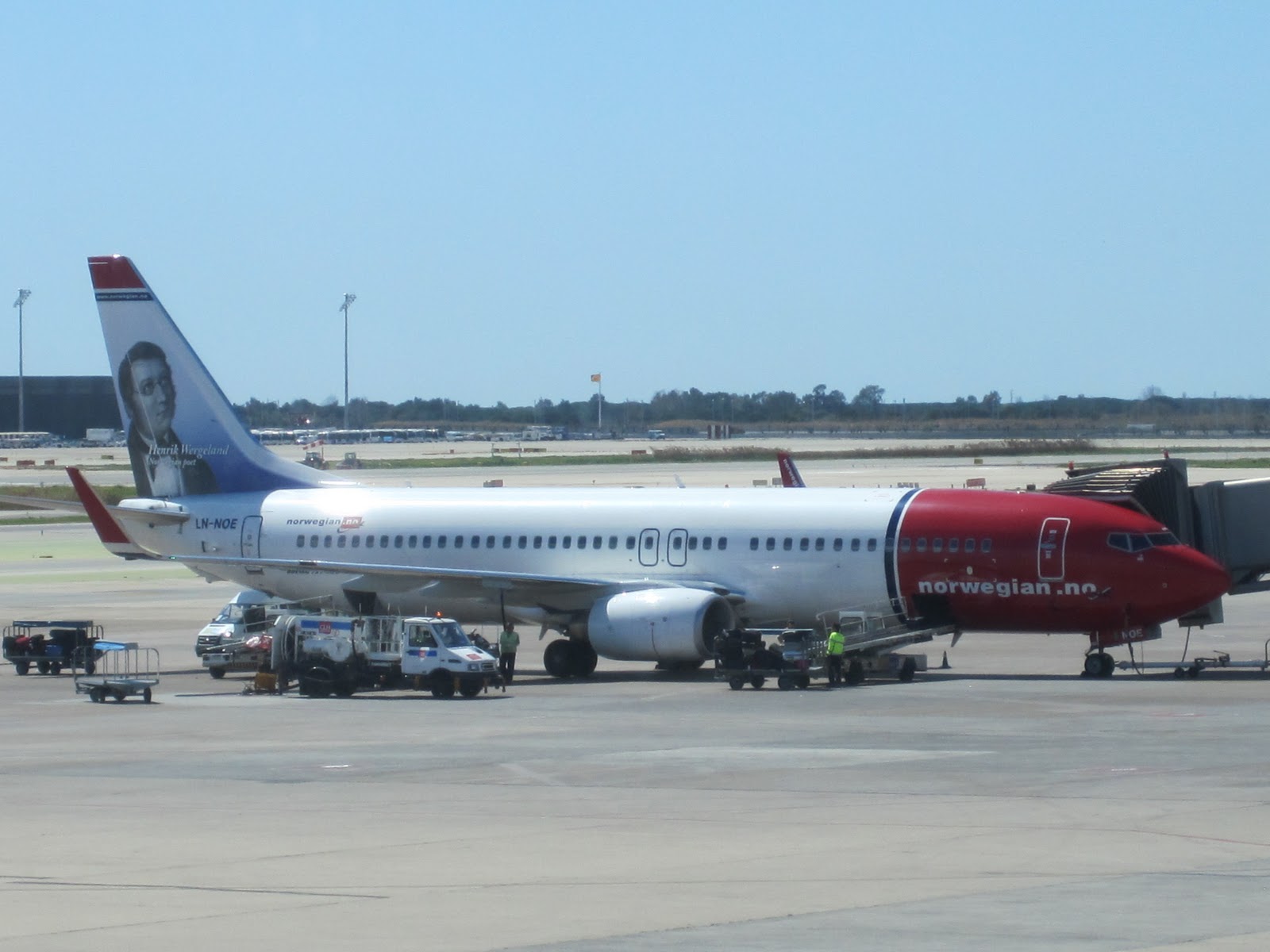
 Norwegian plans to go long-haul as soon as it gets its new Boeing 787s

And we are starting to see some movement among European airlines too, with Norwegian leading the way, and XL Airways in France are also pondering whether to make the move (Air Berlin is also offering long haul but I would count them more as a hybrid airline rather than low cost). Delays in the production of the Boeing 787 might be delaying some long haul plans (its, in theory, superior economics might help overcome some of the obstacles mentioned above), but looks like the long haul low cost carrier is coming soon to an airport near you!

Tuesday, 23 August 2011

Airbus and Rolls Royce in pole position to equip Russia's major airlines


It looks like the Airbus A380 had quite a successful first appearance at MAKS, the Moscow Aviation Show, that took place last week. Russia is one of the aviation markets where interesting things are currently happening, not least because of the resurgence of the domestic aircraft industry, lead by its star, the Sukhoi Superjet.

But there are no plans for a competitive very large commercial airplane to be produced in Russia in the foreseeable future at a time when Russians are increasingly traveling abroad, no wonder airlines are looking to upgrade their long-haul, wide-body fleets (it also helps that taxes on >300 seats imported aircraft have been recently abolished).

Whereas Boeing was the manufacturer of choice when Russian carriers first renewed their fleets in the post-Soviet era, Airbus is making important advances into the Russian market. First it was Aeroflot ordering A330s and A350s, now we hear that the Russian flag carrier might be interested in acquiring up to 5 A380s. This would be great news for Airbus, but also for Rolls-Royce, the possible engine supplier of choice with its Trent-900, the engine that powers the majority of A380s flying today (Rolls-Royce Trent-700 was already selected to power Aeroflot's new A330s), not because of the size of the order "per se", but because of what it represents in terms of visibility and its consolidation in the Russian market.


Transaero is another airline said to be interested in the A380. Russia's second largest airline is adding long-haul capacity at a frantic pace, it is adding Boeing 747-400s with high-density configurations (ex-Japan Airlines aircraft fitted with up to 525 seats) as well as former Singapore Airlines Boeing 777s (by the way, also equipped with Rolls-Royce Trent engines). If it is able to fill all these Jumbos, why not go for the A380, then?

Thursday, 8 July 2010

The A380 and the American carriers

While Airbus is racking record orders from the Middle East for its A380 giant plane and more modest orders from European carriers, such as Air France and Lufthansa, the US market seems to be out of bounds for this model. In fact, there is nothing new with this, the next-largest Boeing 747 was also popular in Europe and Asia, but not among American carriers.

It looks like the economics of very large aircraft are not attractive enough for a bunch of network carriers that for most of the last two decades have been focused in a dire financial situation. Moreover, the American air market with its multiple hubs might be better served with smaller planes providing more frequencies, whereas European, Middle Eastern and Asian flag carriers usually serve a single mega-hub.

Here is an interesting article in the WSJ Middle Seat Terminal blog that comments on the possibility that the last wave of consolidation among US airlines, with the mergers of Delta and Northwest on one hand and United and Continental on the other, could pave the way for fresh A380 orders from across the Atlantic...a move that would be certainly welcome in Toulouse, that is becoming increasingly dependent on one single airline, Emirates, to make its A380 programme break even some day in the future.

Thursday, 18 February 2010

Planespotting in India (II)


An Indigo Airbus 320 queueing behind us, an Air India Boeing 747 in the background


A Jet Airways Boeing 737 on the runway

...and here some pics taken in Mumbai when we were queuing to take off. They were taken at dusk and in misty weather, hence the quality is not the best...

Monday, 15 February 2010

Unusual planespotting opportunity at Stansted

The spell of bad weather that the British Isles endured last January had the unintended consequence of providing some unusual planespotting opportunities. Here are some pics taken while I was waiting to board my Easyjet flight at Stansted airport (STN)...yes, this is Stansted! neither British Airways nor Virgin Atlantic have moved home...what happened is that the severe weather forced the closure of Gatwick (LGW) as well as other airports in the South-East of England at different times during the first weeks of January and planes had to divert to alternative airports(as seen in the pictures, weather conditions at Stansted were also far from ideal!). Birmingham airport (BHX) also took some diverted flights (including some Stansted-bound flights, as the Essex airport was also forced to close temporarily), the Birmingham Aviation Enthusiast's Group took the opportunity to post some nice pictures in their blog.


Foto: VA Boeing 747 "Virginia Plain"


Foto: British Airways Boeing 777

Saturday, 26 September 2009

What airlines go for an all wide-body fleet?


Photo: Japan Airlines Boeing 747 taking off, by Yamaguchi Yoshiaki from Japan under a Creative Commons Attribution ShareAlike 2.0 License.

The typical European or American network carrier has a mix of narrow and wide-body aircraft. The goal is to serve an heterogeneous mix of destinations, long and short haul, that have different densities of traffic. However, there are a few major airlines in the world that have opted for the all wide-body, long haul fleet. In what is their model different with respect to the mixed fleet carriers?

The only European one of the lot, Virgin Atlantic, is a rare bird, it is not a network carrier, but a long haul point to point carrier. It is remarkable that, although it has a network of partner airlines, Virgin Atlantic does not have feeder operations of its own. It is difficult to think of a city other than London that could currently generate enough international traffic to support such business model. Singapore? Dubai? Well, these are different stories...Singapore Airlines and Emirates are actually network carriers, we could call them global network carriers, because, whereas most European network carriers operate a short-haul to long-haul network, these two airlines operate primarily a long-haul to long-haul one, connecting people across continents. A wide-body fleet is a necessity for them, and although they also fly to some destinations that are close to their bases, the savings that arise from having a more homogeneous fleet probably more than compensate for having a long-range plane making short hops. This business model has got a tremendous impulse with the increase in global commerce and international traffic of the last decade, and other airlines, particularly in the Gulf have also gone this way (Etihad of Abu Dhabi, Qatar Airways,...). Building such an intercontinental network requires a huge capital investment (a brand new Airbus A380 can cost up to $275M)...and then you need to fill lots of seats! so it shouldn't come as a surprise that most of the airlines following this model have been set up by investors with deep pockets for whom building a hub is part of a grander economic and financial strategy for their respective territories.

And now we turn our attention to Japan, because to the European observer it is simply amazing to see an entire fleet of jumbos serving only the domestic market. Japan is not a huge country in terms of landmass and it is also well served by an efficient high speed rail network...high population density must have been the main reason behind the fact that some short domestic routes in Japan being served by Boeing 747s, that in other parts of the world would be reserved for the densest long-haul routes. If capacity (some Japanese jumbos can carry up to 550 passengers) is the main factor, why then this model has not been adopted elsewhere in high density routes, for example in China or India or in the busiest European and American routes (London-Amsterdam, Barcelona-Madrid, NY-LA)? Also, and surprisingly enough, no Japanese airline seems to have shown interest in the A380, maybe it has to do with the critical financial situation of Japan Airlines? or with Japanese airlines having a historical preference for Boeing?

Monday, 3 August 2009

Barcelona airport (BCN) or how to cope with simultaneous demand and offer shocks

foto: Terminal 1 by Ricardo Bofill (from Creative Commons)

Barcelona airport got its new terminal last month, almost doubling its capacity overnight, this would be alright was it not for the simultaneous demand and offer shocks the airport is facing.

Although designed in times of double digit growth the new terminal opens when the airport is experiencing its first decrease in passenger numbers in a very long time (-15% in the first quarter of 2009 compared with the same period last year). Europe is in the midst of one of the worst economic crisis in living memory and this would be worrying enough for an airport that relies almost exclusively on short and medium haul traffic, but is even worse when considering that the Spanish economy is among the hardest hit by the crisis. Tourist numbers are plummeting and some airlines have been cutting services (Easyjet has reduced capacity, British Airways is axing its Gatwick services). Other factors are contributing to the fall in numbers, the new high speed train link between Barcelona and Madrid has taken half of the market of the densest and most profitable route from BCN.

The recent merger between Clickair and Vueling, with the resulting company controlled by Iberia, is expect to bring some rationalization on some routes where the two companies had overlapping services. In the long term this might result in a stronger company able to maintain its base at Barcelona (Mr.O'Leary would probably disagree...).

And talking about Ryanair, the offer glut has not prevented Ryanair from opening a new base at Reus (REU), about one hour drive south of the center of Barcelona, to add to its current base at Girona (GRO), about one hour north. It seems that Ryanair is doing well in Barcelona (surely helped by the popularity of the city among the European city-breakers and young travelers). there was even talk of Ryanair eyeing slots at BCN...we do not know whether has there been a firm offer but it seems that the company expected some concessions that Aena was not ready to grant.

There is certainly the concern in certain sectors of Barcelona business and political spheres about BCN becoming an almost exclusively low cost airport. Hence, the takeover of the the troubled airline Spanair, engineered by a Barcelona-based consortium with the support of Catalan institutions, with the objective of making it the "Barcelona airline" (Vueling might also have some claim to the title). The hope is that its membership of Star Alliance will help Barcelona to become an alternative Iberian hub (although smaller than Iberia and Oneworld's at MAD). A challenging task indeed!
The reality in the short term is that Spanair does not have any long range plane in its fleet, so the long haul hub might have to wait, however the recent success of some Star Alliance partners at BCN (like the Singapore Airlines connection) allow for some optimism. Maybe Spanair could be a regional distributor, in the South-West of Europe for its long-haul Star Alliance partners? or will it continue to be a feeder for Lufthansa (a sort of Air Dolomiti)? time will say...the truth is that if it is currently difficult for BCN to become a hub, it has never had it better, since it is the first time that BCN is the base of two airlines of a respectable size.

Therefore, and despite the crisis, I am bullish on the long run prospects of BCN. It is the gateway to a densely populated and relatively rich area, with a diversified economy and some of the top tourist destinations in Europe. The airport itself is very close to the urban center (although could be better connected by public transportation with its hinterland)and there might well be a latent under served demand for direct long haul travel that is currently flowing through other airports (mainly MAD).

The 747s of the image might never materialize (smaller planes like the 787 might stand a better chance at BCN) but as Ryanair has proven at Girona (from nearly 0 regular traffic to 5,5M passengers in just over 5 years) sometimes offer can create its own demand...

Thursday, 23 July 2009

Planespotting at Heathrow T-5


I recently found myself for the very first time at Heathrow's new Terminal 5. The views were very good, as the new modern buildings provide a considerably better view than any than any the old terminals, however, the terminal is totally monopolized by BA, so there was no much variety in the type of planes to be spotted. I have to admit, that the venerable 747 remains a very impressive aircraft though!

Planespotting at Domodedovo


We are at Moscow's Domodedovo airport, after a really intense week, ready to board our British Airways flight to London. While I look through the windows at the waiting lounge I realize what an exciting place for plane spotting can a Russian airport be.

At most Western airports, for example, around 95% of the planes are either Boeing 737 and those of the Airbus 320 family, in airports with a large number of long haul flights, like Heathrow you can also see Boeing 747s and 777s and 767s or Airbus 340s and 330s. But at a Russian airport you can see all of these plus a whole range of old soviet-era planes, new Russian planes and second-hand Western planes. This picture is a great example of the situation of aviation in Russia.

Let's have a closer look: in the foreground an old soviet-era Tupolev 134 of Rossiya Airlines, next to it an Airbus 310 of S7-Sibir Airlines, one of the largest domestic airlines in Russia. The A-310 although not a particularly old model is hard to see in Western airports as it was not as commercially successful as the A-320 and A-330 models. Further away is another S7 plane, an Airbus of the A320 family. Russian airlines have been adding new Boeing and Airbus planes that are progressively replacing the old soviet models.

We can also see 2 planes from Transaero, Russia's second international airline (the first is Aeroflot), a Boeing 767 (right) and a Boeing 747-200 Jumbo (left), two wide-body long range planes that probably transport Russian tourists to resorts in the Mediterranean, that are popular destinations from Domodedovo.
In the background there is a large number of parked planes and, although it is difficult to tell from this picture, they are mostly soviet-built. For example, just behind the tail of the S7 Airbus 310 there is an Ilushyn IL-96, the Russian equivalent to the Airbus 340, of relatively new design, but that has experienced some problems that have prevented it from selling in larger numbers.

In summary, quite an interesting mix, that is probably going to become more homogeneous, as Russian carriers update their fleets, but as the restructured Russian aircraft industry gets back to the market with new models, it might continue to be more diverse than in the West.